The real thing

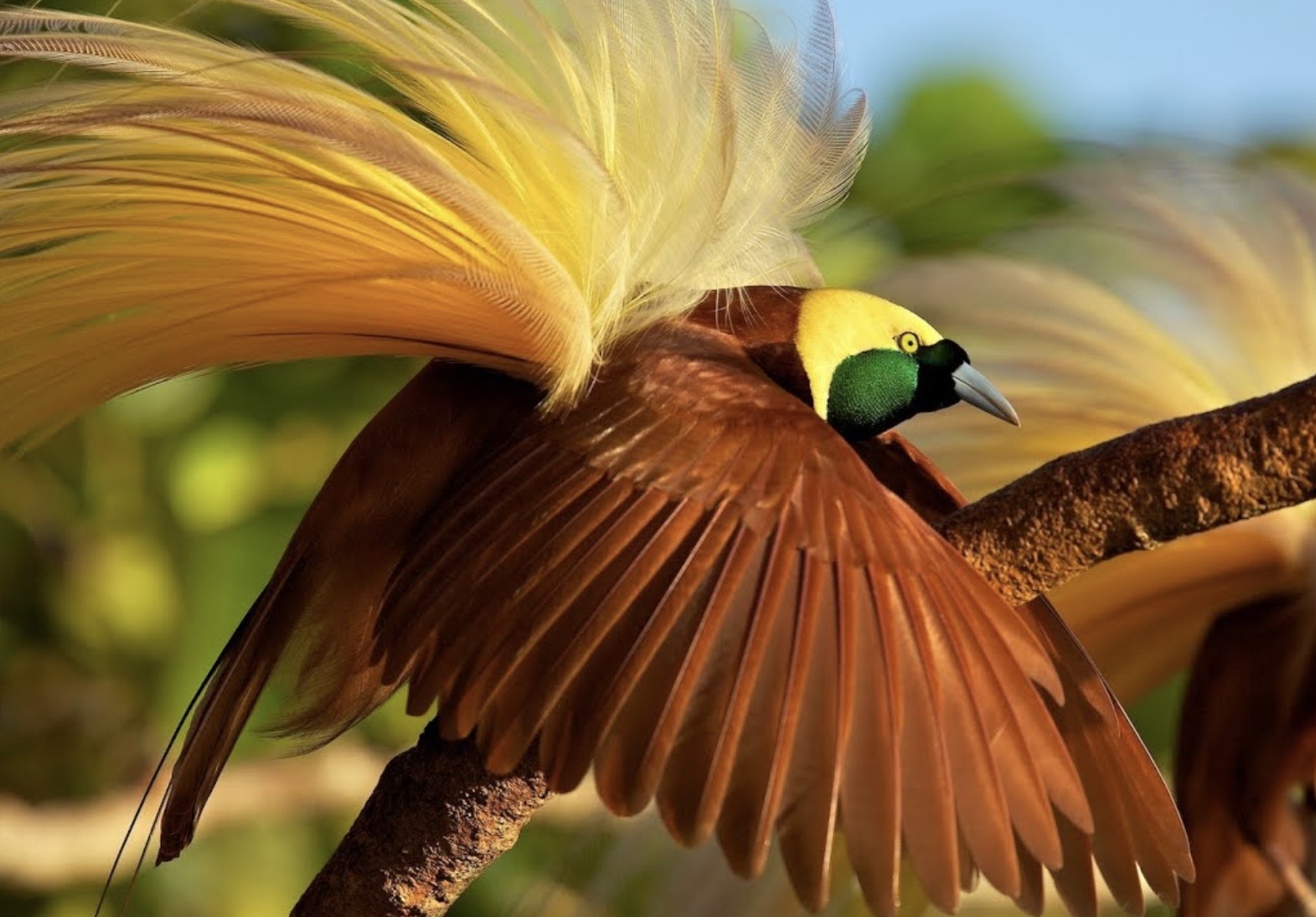
The name Bird-of-Paradise, although originally intended for an exotic bird, is also the popular name of a beautiful flowering plant. After all, the flowers bear a striking resemblance to the bird’s colorful plumage and the shape of its beak. First observed in New Guinea by Europeans in 1522, the bird’s unforgettable appearance spawned myths of having arrived directly from heaven. As a result, the storied fowl became synonymous with power and wealth. Eventually the bird achieved peak status as the National symbol for Papua New Guinea representing freedom and independence.

In contrast, the flower by the same name hails from South Africa, growing wild along the coast and river banks. You might say they are “normal” there. However, in 1773, along came Sir Joseph Banks, a Botanist who recognized the flora as extraordinary, and took the treasured plant back to his home in England, placing his prized specimen in the Royal Botanic Gardens. Due to the striking resemblance between the flower and the bird, the borrowed name “Bird of Paradise” stuck and became the common moniker that followed the exotic plant as it migrated into every warm, frost-free climate around the world.

The incredible Twin

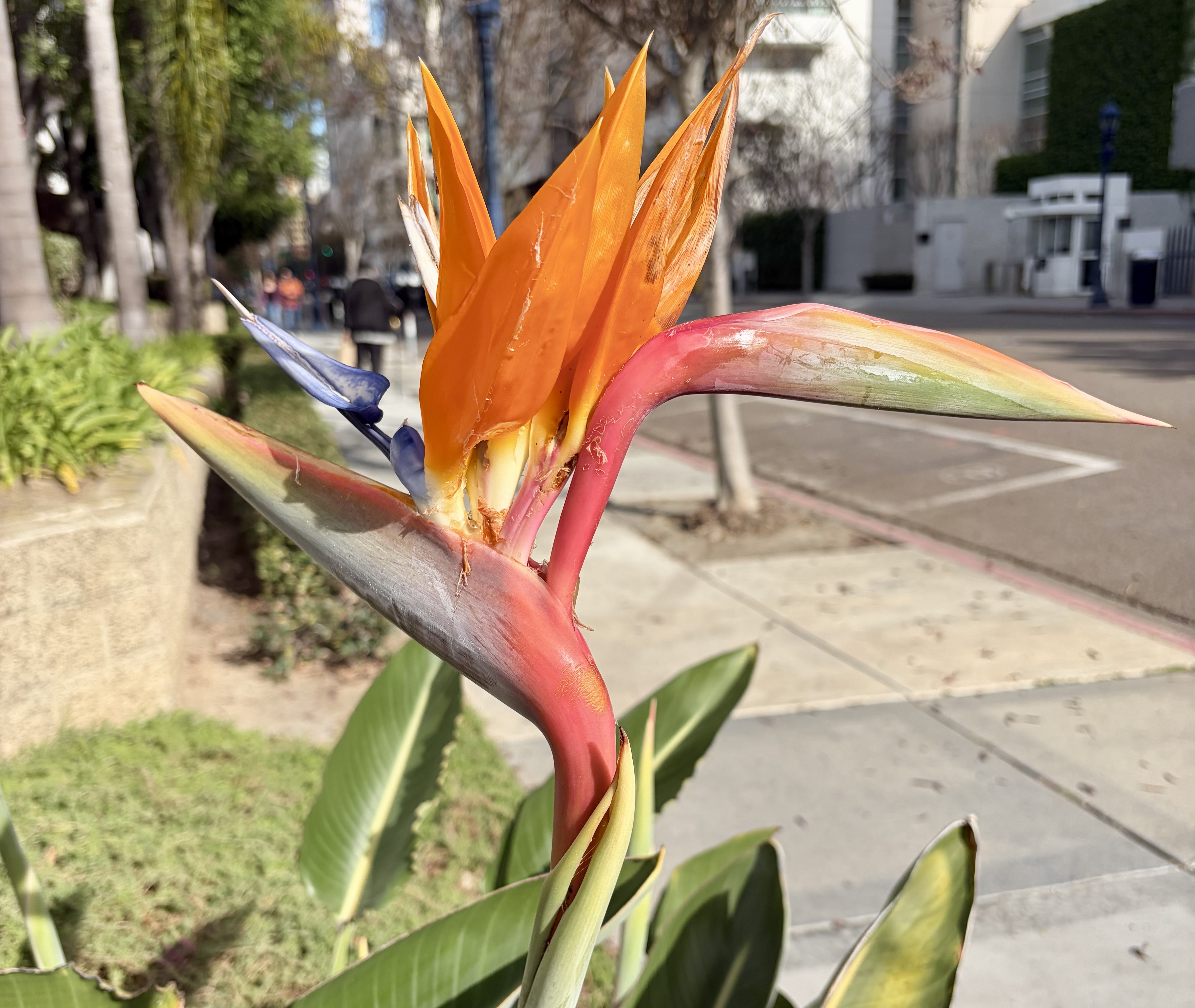
That brings us and our story to one of those warm climates some 250 years later. We were walking in downtown San Diego the other day, as part of our daily routine to a favorite coffee shop. We passed apartments and condos along the way, and by chance, came upon a couple photographing a particular flower (He was apparently the designated photographer while she provided the necessary narrative). There in a flowerbed outside their condo stood one of those gorgeous “bird/plants,” strutting its stuff. We paused to watch as she circled the bloom, swooning and describing its unique qualities. Evidently, what we were looking at was no ordinary “bird-flower.” This one boasted two opposing “beaky things” rather than just one. She declared the anomaly to be a “twin,” and excitedly proclaimed its virtues. This phenomenon of “twin beaks” may or may not be rare, but she was quite taken with it and so we chose to accept her narrative.

For us, this chance encounter with the enamored couple and their flowering Bird was a classic moment where a variety of interesting details came swooping together. A coincidence? A serendipity? Who can say?

In this curious age of AI and “created” reality everywhere we look, we intuitively stopped to briefly connect with real life. We were reminded that there are flashes of sweetness all around us all of the time, we just need to stop and notice. Sometimes we get distracted with “Breaking News,” politics, and world events that are overwhelming. Yet, on a regular Monday morning walk, out of nowhere, various snippets of life from hundreds of years swirled together into a magical encounter. We experienced a heavenly Bird of Paradise that metaphorically flew down and landed at our feet.

Note: The famous Papua New Guinea National Flag with the Golden Bird of Paradise representing freedom and emergence, and the five stars representing the Southern Cross—their proud Pacific location and cooperation with the other Pacific Nations.

Papua New Guinea Flag

Related Story

Monarchs Rule

The Unexpected

Today, an unexpected guest arrived at our home. On a beautiful sunny, cloudless June day in San Diego, something amazing happened. Following our lunch on the patio, we left the door wide open to let outside breezes in. Suddenly, there was a fluttering—a shadowy silhouette against the stark white ceiling.

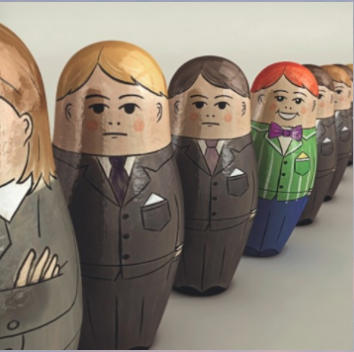
This quote is from the Lyrics of the musical story called Follow the Leader.” We all participate in the spectacle of the showman at one time or another whether we know it or not—for good or sometimes not.  Just click the link above and you’ll be whisked away to the original story, music, lyrics and more.

Follow the Leader


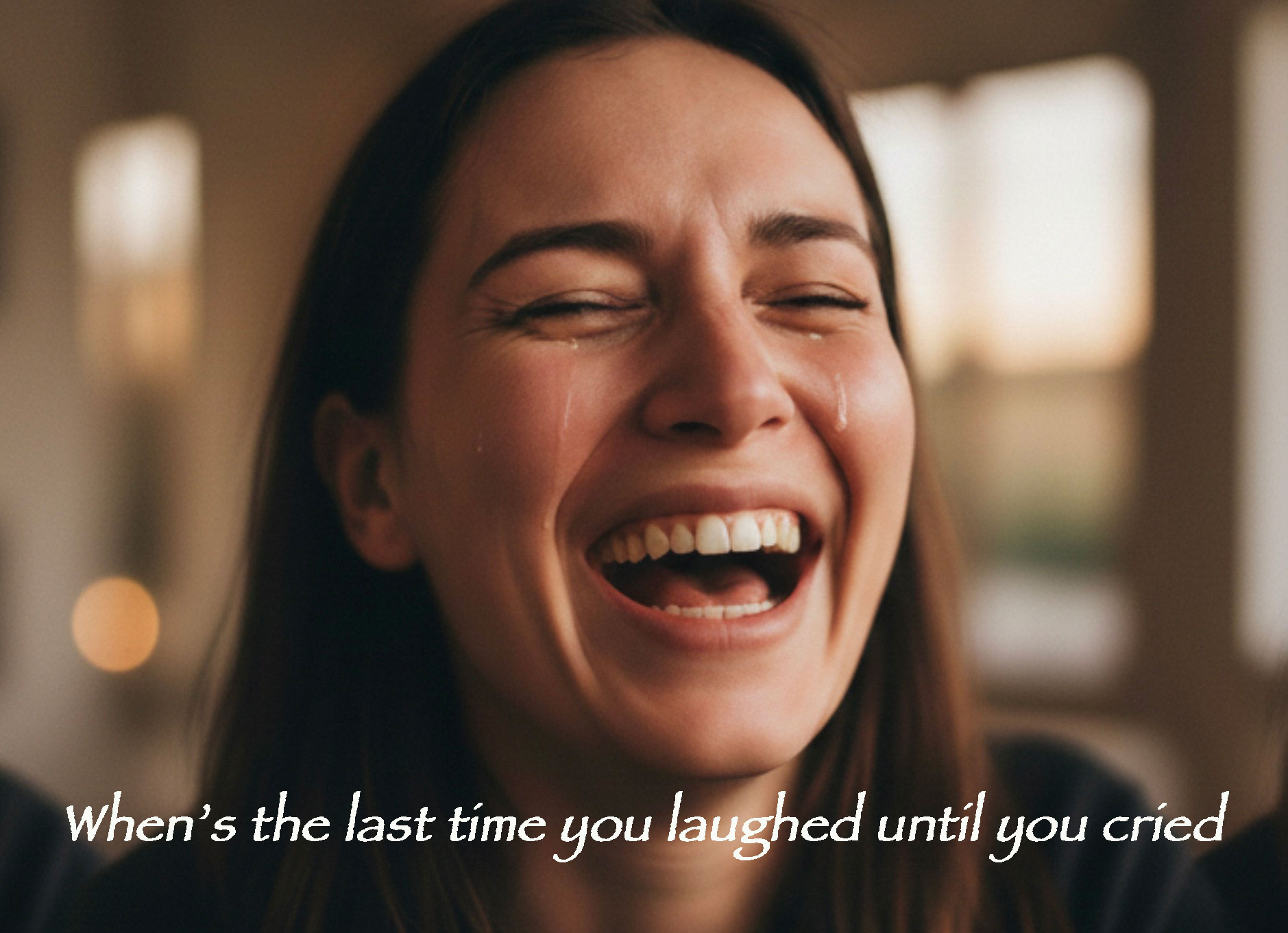
This quote comes from the lyrics of the song calledLittle Things.” Can you remember that last moment that crept up on you and you laughed so hard that you experienced rare tears of joy? What was it that brought about such a powerful visceral response? Buried within that moment is a treasure-trove of information about some part of you. Aren’t we all puzzles, piecing together the aspects of who we are? Take a look inside—there may be a surprise awaiting.

Related Story

Yesterday Me

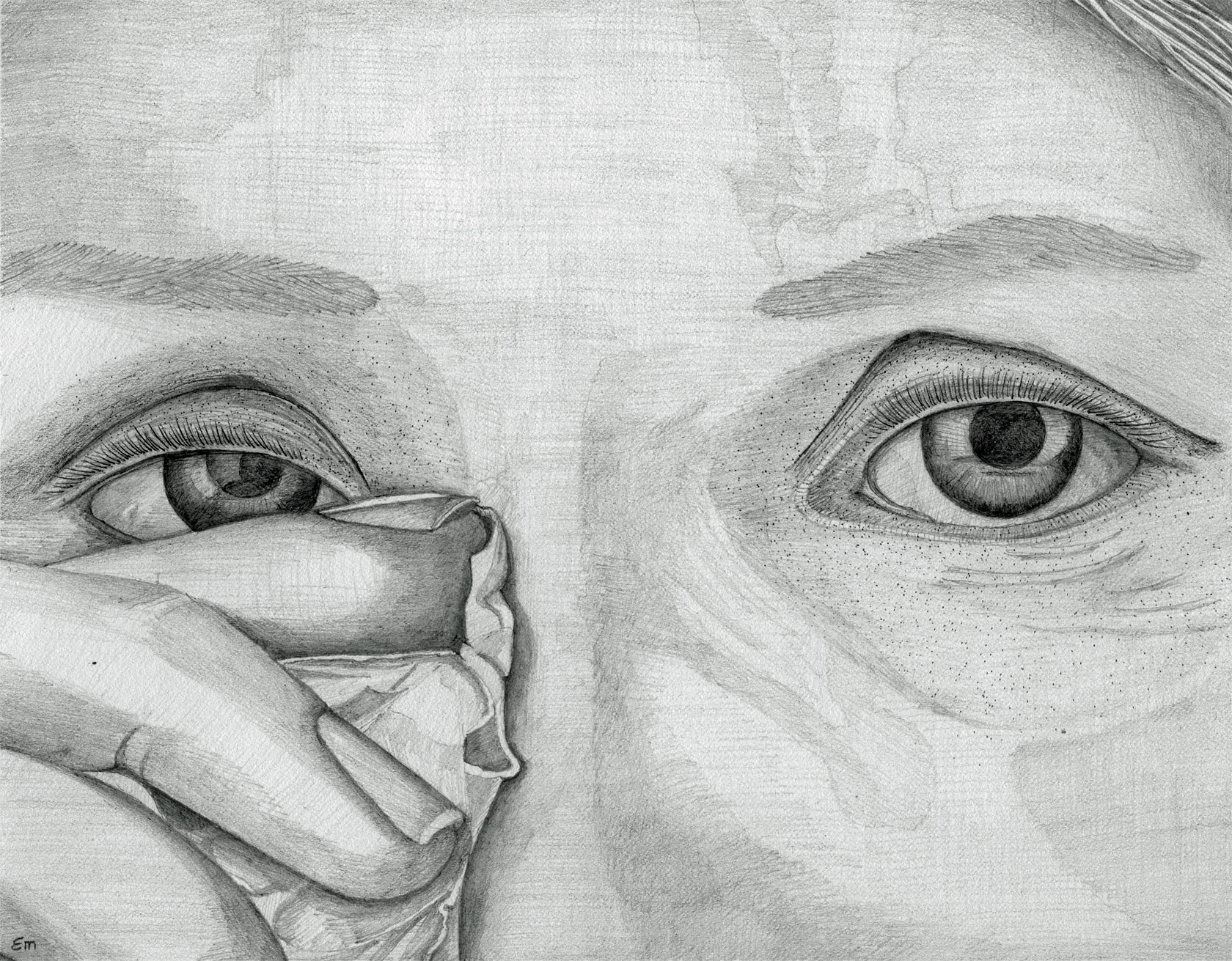
Understanding the origin of tears can take a little digging. Do I cry because a tender moment surfaces from my memory bank ? Maybe a secret longing has awakened and it leaps into my throat. Are my tears ones of joy or sadness? Perhaps the source can’t quite be found or articulated. These lyrics were penned years ago in a story called Yesterday Me.” Although the words weren’t written yesterday, the sentiment persists.

Recently, I read a post online about nature and the relationship between birds and branches. The pondering was simple. Yet the thoughts went deeper. The pondering/wondering went something like this: When a bird nears a branch, does she anticipate the branch’s ability to hold her or does she land without calculating the branch’s strength, but rather trust her ability to fly?

Trampoline trust

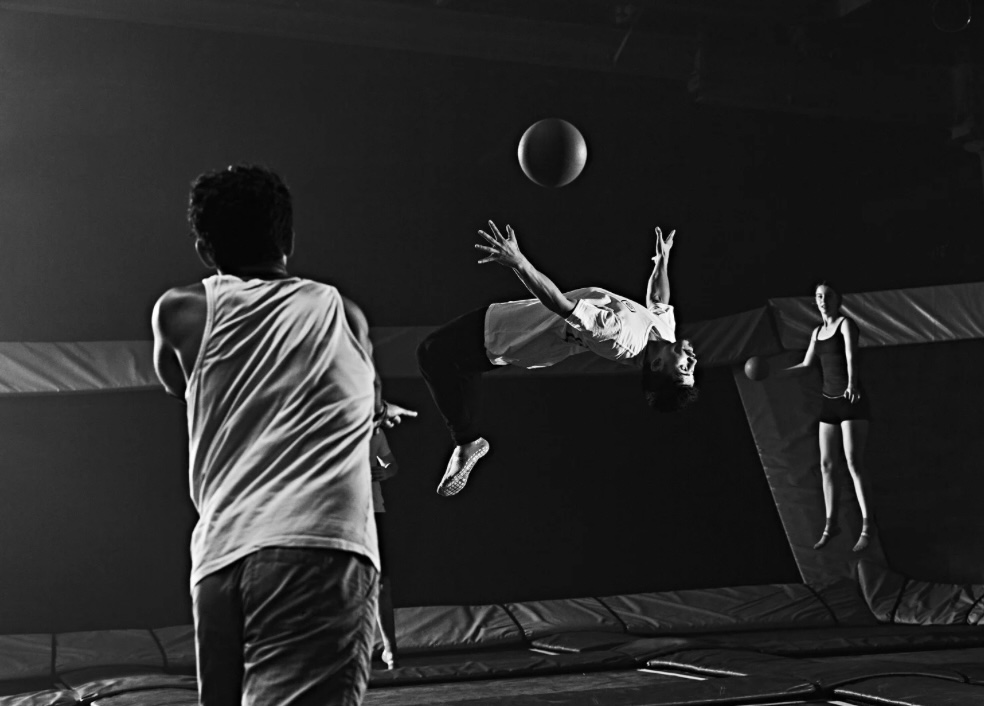
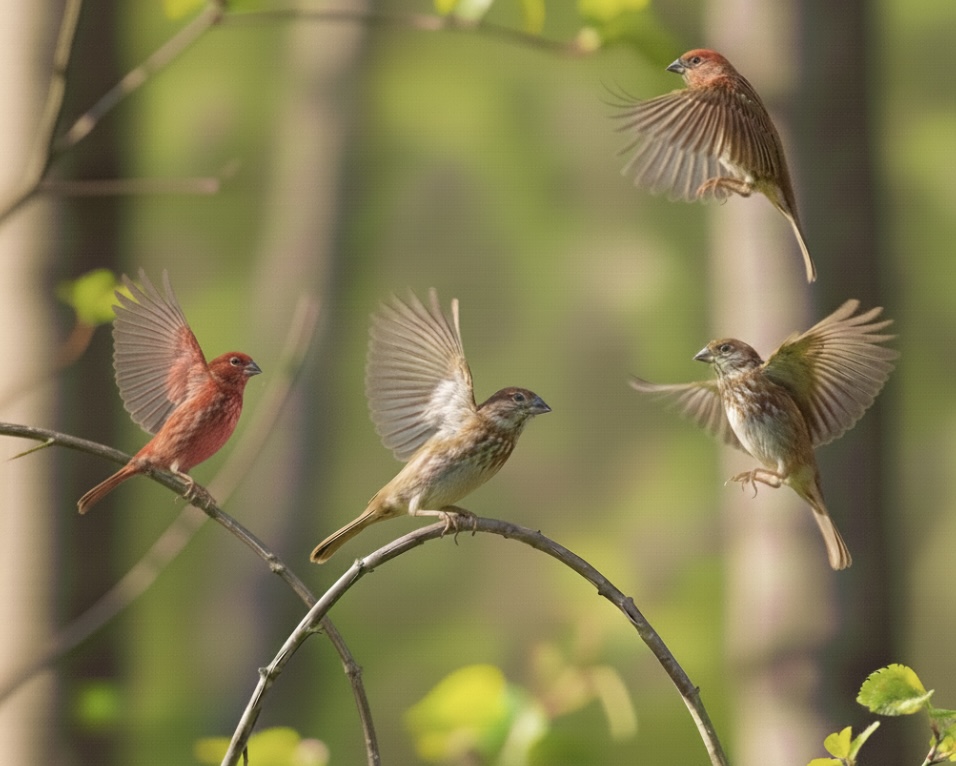
Since reading the post, I’ve been observing birds more closely. The day before yesterday I saw several birds actually using thin branches in a pretty elaborate and playful “dance.” One landed while the others fluttered. A second one landed and the one on the branch immediately  sprang into the air. They resembled trampoline acrobats, engaged in a fascinating synchronized routine. I watched them for several minutes as they continued to create variations of that same pattern. Was it a mating ritual? Was it some form of bird zoomies after the rain? All I can say is that none of the birds seemed concerned about the strength of the branch, even with all of the bouncing. 

Birds trusting the dance

So for me, the post/riddle seems to have been answered. It appeared as if the birds trusted in their ability to land or take flight at just the right moment. Their self-trust allowed them the opportunity to touch and fly, touch and fly. This very practiced routine continued for several minutes. Then suddenly the birds abandoned the swaying branch and flew away. I didn’t see any movement nearby, so I don’t know if they continued their dance on another close-by branch. I pondered their activity and then shifted my focus to humans in relationship with one another. Do we mimic the dance of the birds? Do we decide about whether or not to trust our abilities or do we calculate the strength of the branch? 

At any point in time we could ask ourselves: Am I the bird? Or am I the branch? Is my confidence in myself or do I rely on something to support me? And if I am the branch, who counts on me to be strong enough to hold them? Does holding them keep them from flying or give them a springboard? Is this a mutually beneficial dance we’ve created?

Related Musical Story

Circle of Trust

Circle of Trust: This story is about a relationship of trust for us, that plays out around a campfire instead of on a tree branch. There is a similarity between our flitting exchange of conversation and the playful dance of the birds. Just click the title above to go directly to the story, or have a quick listen-in to the accompanying music below.

Henri in his studio

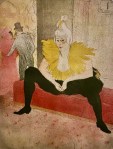
His full name is Henri Marie Raymond de Toulouse-Lautrec-Montfa, but most of us know him simply as Toulouse-Lautrec. He was an artist known for his renditions of the life he lived and observed, as well as for his diminutive stature. Due to a genetic weakness that rendered his bones brittle and vulnerable, he unfortunately broke both legs when he was a young boy. The result was a disturbing stunted appearance. Ever self-conscious about his physical imperfections, he found himself most at home with common people who had their own obvious flaws. He was especially drawn to the fascinating theatrical lifestyle of Paris in the late 19th century, even though, as his hyphenated name suggests, his family had deep aristocratic roots.

Playful self portrait

Toulouse-Lautrec became a famed artist, printmaker, master caricaturist, draughtsman and illustrator during his short life (1864 to 1901). He was also a gourmet food lover who invited his guests to dine with him via formal, artistic invitations. He even described the anticipated menu and commented that a meal was very similar to any other artistic expression—full of color, in both the foods and the guests. Meals and people were meant to be savored and shared. He often directed conversation to inspire lively exchanges.

Can-can dancers

Lautrec’s many associations in the vibrant milieu of Paris’ Montmartre district allowed him simultaneous front row and backstage views of that world of wonderfully “imperfect people,” like him. He was deeply immersed in the imagery of decadence—empathizing with the every-day plight of the working-class characters swirling around him, performing in the theaters. The famous Moulin Rouge (Red Mill) drew boisterous crowds, Lautrec interpreted them to be willing subjects, part of the “show.” The frenetic energy of the “can-can” invigorated the audience. Brothels of the area added to the attitude of decadence and pleasure. Lautrec enjoyed all of it, leaving a colorful, artistic “journal” for us to understand and appreciate his contribution to a rapidly evolving world of art. Although Lautrec enjoyed success and notoriety while he lived, he was destined to succumb to his circumstances and choices. An illness abruptly ended his life when he was merely 37 years old.

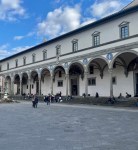
Ospedale

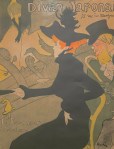
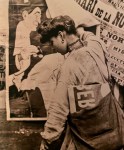
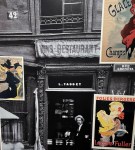
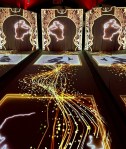
We think Toulouse-Lautrec would have found this exhibit to be the perfect expression of his artistic flair, since it was such a unique presentation. The historic corridors of the space were transformed into Parisian passageways that transported us back in time. Anchoring one side of the Piazza Santissima Annunziata, the beautiful RenaissanceOspedale degli Innocenti” was the perfect choice for the exhibition. The 1419 architectural masterpiece was conceived by Fillipo Brunelleschi as a Children’s Hospital and Orphanage to support and care for the children abandoned during the Florentine Renaissance. (Brunelleschi also designed the famous dome of Florence’s grand cathedral—il Duomo.) The contrast of the exquisite historical building with Lautrec’s avant-garde style accentuated both.

Seeing 19th century art with 21st century eyes has become “normal,” yet to have that experience in a 600 year old architectural gem seems almost miraculous.

Stock Photo

Coming back outside into the brilliant Florentine sunshine, after having spent a 90 minute immersion into the late 19th century underbelly of Parisian cabaret life was a bit shocking and overwhelming. We had just glimpsed inside the life and mind of one of the world’s most influential artists of the late 1800s.

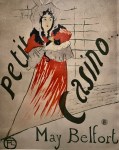
Following is a video of a “passageway experience” within the exhibit, along with a few amateur snapshots of his masterful work. Notice how accurately he captured the essence of a complex personality with a single, delicate line of the face, the audacious glint of an eye, or the subtle slant of an expressive black hat—absolutely fantastic!

Passageway Video

Cabaret Video

Gallery

New and fast friends

“How did you two meet?”

This is an age-old question, often used to jump-start a conversation.

“We met in a class, freshman year at college.”

“We met online, in a dating website.”

“We met through mutual friends.”

“We were “fixed up” by a well-meaning friend who knew someone seemingly “perfect” for me. 

“We sat down on opposite ends of a sofa at a party and just started talking.”

“We literally bumped into one another at a concert.”

“We met at a coffee shop one morning, standing in line.”

“We both took our dogs to the park one day and they wanted to greet each other”

However the first encounter happened, it’s still something of a miracle given all the random possibilities. The fact that two people meet and really connect with one another is an amazing phenomenon. We were reminded of that recently when a friend “clicked” with someone, seemingly out-of-the-blue and they’ve been inseparable since.

Keys to a heart

He swiped right, She swiped right. They met for tea. Then they met for lunch. Then dinner. Once the “interest seed” was planted, the relationship blossomed. They discovered common values, preferences and humor. It rapidly went from being a possibility to being “something.” They’d each hoped to find a “significant other” and cautiously began an earnest search—romantic details as well as practical considerations were clearly in mind. She wanted X characteristics and he wanted Y. Each was determined to find a kindred heart to unlock.

Hidden treasure

Each was primed and felt determined to find the exact person who would match their descriptions. What were the chances? 50/50? Daunting? One in a million? Our friends took a deep dive into the proverbial haystack and re-emerged with a prize—the ever-elusive needle. Sometimes fate steps in and treasures can be found. Dreams can become reality and love grows, however unlikely it may seem.

Don’t you just love happy endings?

Music—Meant to Be

Related Music and Story—The First Time We Met

You can also find a collection of songs/stories about soulful relationships written over several decades of an evolving partnership, in the album called “Love Stories.”


Not so steady

We circled the flickering campfire as the balmy day gave way to a cool evening breeze. Quietly inspired by the massive peaks standing watch over the rugged southern California landscape, a momentary hush fell upon us. The day’s end encouraged reflection. Clearly this was a Kumbaya moment, with the expectation of guitar accompaniment. Our daughter scanned the scene and then asked her dad if he brought his guitar. “Nope,” came the matter-of-fact reply. “Why not?” she asked, disappointed. Em searched for the right words, “Because my hands aren’t as steady as they used to be. In fact, I don’t really play just for enjoyment anymore.” Iris’ tone softened, “I didn’t know that.” 

Just a dusty memory

Even without songs around the campfire, our adventure was still a delight as we made some sweet memories together. But, that lingering fireside question about the guitar triggered some reflective moments the following day on the drive home. For the past 50 years, we’ve written music and sung together, accompanied by a guitar—always a guitar. We were college-age during the folk music years and imagined that we’d just continue in that mode. The simple question during the camp-out prompted conversation that uncovered a looming realization that our musical form of self-expression is limited. At 71 years of age, we expect a dimming spotlight on our favorite pastime. Perhaps only a certain number of songs remain to be written—20, 15, single digits?

Life certainly has its earthly limits. We’re painfully aware of the ever-diminishing natural resources in the world around us. As much as we try to stay focused on abundance, there’s a subtle ever present thought that scarcity does exist. Everything eventually gives-way to the ages. So, the realization of personal limitations is not really a big surprise. 

For us, abundance and scarcity show-up together. Everything is defined by its opposite. Rather than deny the negative aspects, why not look for their value? How can we accept and even find peace with something that we interpret as negative? Acceptance, integration and transition are steps needed to embrace the whole. Maybe pesky tremors can actually point the way to new and surprising possibilities. 

Our path, for now

Our conclusion: We’ll continue walking our current path with whatever brings us joy for as long as we can. Then, one day an urge will cause us to shift. Maybe we’ll find ourselves being nudged closer to the next dream as Em’s once-steady hands lay down the guitar. That moment will be our pivot-point, when we turn from that which we love and have loved, to something new—perhaps even better. The essence of those curious inflection points in life is captured beautifully in the following poem, “Snowbanks North of the House,” by Robert Bly—from his collection called The Man In The Black Coat Turns:

The mystery of “Why?” remains, quietly hidden in the “When?” We remind each other to “just be nimble.”

Snowbanks North of the House

Those great sweeps of snow that stop suddenly six
feet from the house …
Thoughts that go so far.
The boy gets out of high school and reads no more
books;
the son stops calling home.
The mother puts down her rolling pin and makes no
more bread.
And the wife looks at her husband one night at a
party, and loves him no more.
The energy leaves the wine, and the minister falls
leaving the church.
It will not come closer
the one inside moves back, and the hands touch
nothing, and are safe.
 
The father grieves for his son, and will not leave the
room where the coffin stands.
He turns away from his wife, and she sleeps alone.
 
And the sea lifts and falls all night, the moon goes on
through the unattached heavens alone.
 
The toe of the shoe pivots
in the dust …
And the man in the black coat turns, and goes back
down the hill.
No one knows why he came, or why he turned away,
and did not climb the hill.


Credits

Title inspiration:  “Jack Be Nimble,” the 1800s rhyme from England. Good luck was ascribed to those who could jump over a candle stick without dampening the flame. May we all aspire to such daring and resolve in the face of challenge!


Related Story and Music: Turn Around

“How much is that doggie in the window
The one with the waggly tail
How much is that doggie in the window
I do hope that doggie’s for sale”

Patti Page popularized the novelty song, “(How much is) That Doggie in the Window?” in 1952, when we had each achieved the magical age of 1. The answers to those questions were clear for us even as children and became underscored as the years went on. Here are the questions, followed by our answers: “How much?”—”priceless” and “For Sale?”—”not a chance.”

Doggie in a bag

If you want to have some fun, put a dog in a carry bag (preferably a small dog) and take it everywhere you go. Doing this in Italy resulted in our pooches becoming our “doggies in the window,” attracting the attention of many passers-by. We began with our dearly departed Izzy-B. Her name was Isabel, but Italians knew her as “Ee-sah-bella.” She was a real sweetheart who graciously allowed us to carry her everywhere—the grocery store, restaurants, running errands—the destination made no difference to her. She never uttered one complaint or showed a lack of enthusiasm. She seemed to bask in the attention of all the friendly folks who greeted her.

After 2 years without a doxie, we adopted her successor Sara, pronounced “Sah-dah” in Italian. We’ve had strangers scheming to sneak her into forbidden places, while others have screamed with glee as they take her little face into both hands to smooch her loudly. Most people can’t resist feeding her tiny treats they carry in their pockets, and we’ve even had her magical power give us direction and grant special favors. Following is just one silly example of the antics:

Doggie in the window

Em needed a haircut in Italy. He’d seen a barber shop in the nearby town of Caldine, just across from the local grocery store. It looked promising, so he thought he’d give it a try. One day, while Cheryl was at the market, he walked over for a trim. As usual, Sara was tucked into her carry-bag and barely visible. The barber spun around to offer Em a seat in the barber’s chair. Suddenly, he saw Sara peeking from under Em’s arm. Barber Giovanni is an avid dog lover and was fine with Em keeping Sara on his lap during the haircut—he simply let the barber’s cape drift slowly down over both of them. Another man entered the shop and Giovanni insisted on giving him a peek at Sara. He carefully lifted the hem of the cape to present a napping doggie. Everyone laughed at the silly sight. Sara glanced up momentarily and then fell back asleep.
Sara: doggie dis-covered

After the long pandemic travel drought, we finally returned to Italy some 2 years later. Although he’d had a few haircuts stateside, Em really liked Giovanni’s technique so he returned to the shop for another trim. As Em entered the barber shop, Giovanni paused over his seated customer. Holding his comb and scissors in mid-air, he greeted Em, “Hello, hello, how’s Sara?”(“Ciao, ciao, come sta Sah-dah?”) Em quickly realized that Giovanni didn’t remember his name—just Sara’s. Em replied that she was waiting in the car with Cheryl, but offered to retrieve her. When they returned, the finished customer stood to leave and Giovanni gestured for Em to be seated. Em placed Sara on his lap just like before, anticipating the same fluttering barber’s cape. Giovanni whooshed the large white bib up and out, then waited for it to settle over them. This time, to Em and Sara’s surprise, there was a new feature in the large cape. A clear window had been sewn into the front of it, seemingly custom-made for a furry friend. Sara was completely visible, giving everyone a hearty chuckle as she peered out through the plastic window (finestra di plastica), a bit puzzled and curious. It may have taken her a few extra seconds to fall asleep. Giovanni explained that the cape-windows are intended for cell phone use. However, we agreed that a dedicated dog-window is much more important and a lot more fun!

So, we return to the original question: “How much is that doggie in the (modified cape) window?”—still “priceless.” We wouldn’t trade our little fur baby for all of Italy, or the entire world for that matter! Our theory was supported yet again: some furry fun is always guaranteed when a dog is in tow.

Related Stories and Music

Puppy Love

Simone and Alessia arrived around mezzogiorno, noon the other day for lunch with us in the country. The sun was bright and the air was clear with that unmistakable fall crispness. We hadn’t seen them for over a year, so it was especially fun for us to have that time together to sit and talk . . .

Simple Pleasures

Sometimes Mondays are all about Tuesday.

What?! Are you confused? Don’t be. Tuesday is the name of our daughter’s chocolate lab. No, Iris does not work in research at Hershey headquarters in Pennsylvania. No, she didn’t adopt her sweet puppy on a Tuesday afternoon, but we do celebrate Tuesdays as double days.

Marking the end of an Era, Mom died on January 19, 2022 at 5 in the morning.

Mom in her 90s

Her lifelong goal was to be 100 years-old, but “Big Rosie” fell a mere 73 days short of that milestone. For her valiant effort and positive attitude, the family has given her a pass and will consider the cherished goal achieved. It broke her heart when our dear dad and her loving husband Harry passed in 2001 some 21 years earlier, but ever the optimist, she never gave up. She was a strong and determined woman.

After some weeks of reflection since Mom’s passing, I’m (Em) overwhelmed with many happy memories. My mere 70 years of life as a “practicing adult” under Mom and Dad’s tutelage have given me opportunities beyond my wildest dreams—too many to recount. However, amid the flood of countless thoughts and emotions, I turn to their legacy of values passed down to me and hopefully through me to our children and subsequently, on to their children as well.

The focused team

Mom and Dad had a shared vision: Love, Faith, Family and Fun. It was just that simple. Those basic elements were apparent every single day in numerous ways. They believed that if they kept their focus on those central values, everything would be just fine—a life full of abundance, success and happiness. It turns out that they were right. It worked!

Memories are the greatest keepsakes that we all inherit, but there were also two tangible memory-pieces that I wanted from them as well. Those two items serve as visual reminders of essential gifts they gave me—those particular attributes that have carried me forward throughout my life.

Dad’s favorite drill

Dad had an old wooden drill that he sometimes used on projects at home. That simple tool now symbolizes his steadfast work ethic and natural capabilities. Constantly busy, Dad made all sorts of things that helped create our strong sense of home—a tireless lover of projects of all types and sizes. He made stained-glass, carved wooden figures and fashioned an intricate plaster replica of the Taj Mahal, loved oil painting and even played an electric guitar. In his spare time, K9VTD became his ham radio presence around the world, giving him untold hours of pleasure. Not many people knew that he built all of his radio equipment from mail-order kits with hundreds of tiny parts he staged and stored in muffin tins. He also designed and built an intricate setting for his miniature train that filled most of the garage, painstakingly making all of the mountains, streams and towns from scratch.

Taking a work break

Any projects that were needed around the house, he did himself. Fortunately, as the youngest I was always his sidekick, learning by both watching and doing. He taught me resourcefulness, commitment, perseverance, kindness, patience and problem-solving. To this day, I’m a willing volunteer if something needs a little adjustment or major repair. For me that simple wooden drill captures all of those wonderful qualities he quietly wove into the fabric of who I am. The many lessons and skills he taught me, by example, have served me well.

Mom’s tap shoes

Mom was the consummate mother who resumed tap-dancing at 50 years old—all I wanted was her patent leather tap shoes. She loved to dance as a child with her older sister, Margaret, on the Garfield Park stage. She was a natural performer and it showed-up in every aspect of her life. So when we three kids became young adults, she decided to dust-off her tap dancing skills, navigating her return to the “stage” with grace, dignity and enthusiasm. A young dance teacher gave her lessons and as her “performer” persona reappeared, I saw a new spark of life flash in her eyes. She turned the music up loud and tapped away in the garage where the concrete floor created the perfect click/slide sound. The rhythmic beats echoed as she tilted her head and gracefully extended her arms, swaying and tapping to her heart’s content.

She had no intention of performing for anyone (although she graciously accepted an occasional  request). Mom just loved the process, the practice and the promise—forever a little girl at heart. So, for me those shoes symbolize her love for life and an unfaltering zest in everything she did. Just like Dad, she modeled values, hopes and dreams for us kids. I always saw her as youthful in spirit, socially engaging with others and being as entertaining and joyful as possible. Her tap shoes sit prominently on the living room bookshelf. A quick glance there reminds me to make every minute count as I aim for those same qualities.

The Family project

Mom and Dad together also gave me a tangible model of what it looks like when committed partners create family, striving toward a vision so big it requires a team of two kindred spirits. They produced a legacy of love that continues to trickle down through each generation, soaking deeply into every cell of our being. That’s immortality!

Thanks Mom and Dad for all you gave me. May I allow your selfless gifts to flow through me over the course of my lifetime, hopefully adding my own little tweaks and twists to your beautiful story. The “Rose and Harry” playbook will live on forever.

Love, Emerson (and Cheryl)

Music – “Where Forever Waits”

Related Stories and Music

We also wrote the following stories and songs over the years as the life of Rose and Harry continued to unfold before us:  “Lucky Day,” “Yesterday Me.” “Rocking Chair,”  “Lover’s Leap” and “99 Years,” “Where Forever Waits.”

Credits: The featured image at the top of the post is Rose Louise in 1942 at the age of 20.