Our granddaughter spent last weekend with us.

Her heartfelt message

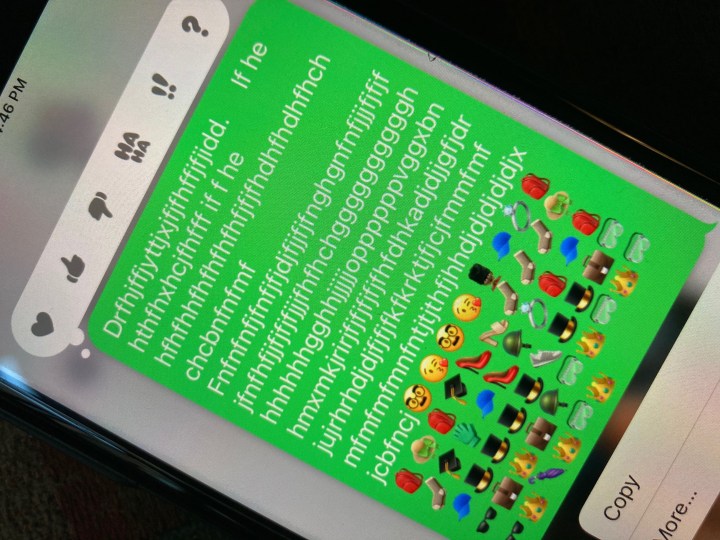
One afternoon, during quiet time, she spontaneously declared that she’d like to send her mom and dad a text. So we opened a phone and set the screen for texting. She immediately started typing and talking. It was amazing to watch her dexterity with the phone, as she narrated her intended message. It was sweet, heartfelt and emotional as she spoke, “Dear Mom and Dad, I miss you so much and send you love from my heart to your hearts.” Her little fingers danced across the keypad. Then, tiring of the meaningless jumble of letters and pretend words, she tapped the emoji button and was immediately delighted with her discovery. She quickly scattered out a smattering of images. Her joy increased noticeably. After a few minutes with many rows of tiny icons, we declared the message complete. Smiling at her accomplishment, she intuitively tapped the send arrow.

Needless to say, her parents were both thrilled and a little confused with the missive. We actually had to do a followup text to make sure they knew it was Rosie’s message and not ours. They later admitted that they seriously thought we might have sent it, which was a bit disquieting (uh, oh, we’re worrying our children now). 

Our sad-face message to Rosie

That next day Rosie went home and early that evening we received her bedtime text. She had taken the liberty (with some supervision) to send us one of her unmistakable messages. Thrilled but not confused, we rapid-fire returned a similar style text to our little communicator. We thought it was great fun to have another way to “play” together. Later that evening, we talked to her mom who told us how excited Rosie was to get our follow-up message, and that she studied each and every emoji carefully to understand what we were saying. Then, she turned to her mom and said, “They must be sad about me leaving. The very first picture is a crying-face.” 

Ah, the power of the image.

Curious, we decided to dig a little deeper into the origin of those amusing little snippets that so frequently lace and illustrate our messages these days. The word emoji actually comes from the Japanese characters forming the word “picture” or “pictograph,” The emoji idea was born in 1997, and the mother of that invention was the company, SoftBank. Erroneously, emojis were thought to have been originally “invented” in 1999 by the Docomo company, but that credit was incorrect. 

2018 Apple Poo
’97 SoftBank Poo

The dispute was finally settled—the credit goes officially to SoftBank. They were the first to create and circulate the initial “emoji set” around the globe. Those little short-hand graphics have become well known and widely understandable icons no matter what age or culture. SoftBank also claims proud authorship of the most iconic original emoji of them all: the “Pile of Poo.” It apparently expressed an essential and versatile sentiment, qualifying it as one of the original 90 emojis. Even today, after nearly 25 years, it still garners ample groans, chuckles and poignancy every time it pops-up.

Pure emotion!

People often assume that the word emoji was derived from the word “emotion.” Not so. But since they can, in fact, capture a complex emotion with condensed accuracy, those clever little symbols are pretty much ALL about emotions. They are tiny compressed Rorschach blots of colorful information with the ability to convey far more than words. They are power-packed arrows that aim straight to the heart of the matter. Emojis communicate where words often fall short. The subconscious has an uncanny way of pulling the essence from a jumble of stuff. That’s exactly what happened with our granddaughter.

It’s true. We were absolutely saddened to see little Rosie June leave, but couldn’t capture the feelings in so many words, “We hate to see you leave,” or “Come back soon, promise?” or “Call us later!” Yet, she got the real message with unmistakeable accuracy since the sad crying face was the first emoji on the text. With such directness, the “true” message was both sent and received.

How simply elegant!

You might also enjoy a related story with music called “Without Words,”

Life is a puzzle.

Iris the Master Puzzler at work

Our daughter Iris has earned the moniker of “Puzzle Master—Master Puzzler,” for a simple and very good reason: that girl can really work a jigsaw puzzle like no one else! She’s been known to stretch across the table to pluck a piece right out of someone else’s hand if necessary. The small cardboard cutouts fly fast and furiously as she pops them in one right after the other. She uses color and shape seamlessly, rarely referring to the box lid for guidance. Upside-down, sideways, sitting or standing makes no difference. Oh, and by the way, she ALWAYS pockets one piece to insure that she gets to make the ceremonial closing play. That’s important to her for some reason, so we all automatically glance her way when searching for the last missing piece. She protests at first, then mock innocently checks her pockets, suddenly feigning surprise. Voila!! She produces the missing piece and righteously pops it into place—definitely one of our best family rituals! 

Each day a new piece

Of course, we see a similarity in our tradition of working family puzzles and working through the “puzzles of Life.” After all, every moment of every day we locate a new piece of the “Life picture”—like an opening into the future, an inviting doorway. We carefully check for fit and color-match, experimenting and perhaps asking, “Does that look right?” Even squinting or shifting perspective can leave us with doubt as we ask the person next to us, “I can’t tell, does that piece fit or am I forcing it?”

Rainy day discovery

While on an early morning walk after an evening rain, Em spied something curious on the brick sidewalk downtown. Oddly enough, it was a single jigsaw puzzle piece. How strange! But in that instant, the lonely lost part flipped a switch in his brain. He had been working through one of Life’s conundrums—searching for a clue, a missing piece or two that would lead to a logical conclusion. Suddenly, everything fell into place. Ahh! That’s the way it magically happens sometimes.

However, we’re not all master-puzzlers and we don’t always magically find the missing piece we’re looking for. Wouldn’t it be nice if Life came packaged in a box with a specific number of pieces and a picture on the front? Would you ever agree to work a puzzle without a picture? We think not. Yet, we patiently fit our lives together, piece-by-piece with very sketchy, if not absent information, all the while knowing that we basically have to work it alone. 

The missing piece of Life’s puzzle

Let’s face it, our little puzzling metaphor has its limits, but there are still some valuable insights: 1) Even though some pieces my be difficult to find, we have to be vigilant and patient to get just the right match; 2) don’t hesitate to reach across the table if necessary when you finally see what you’re looking for; 3) sometimes we need to shift our position to get a fresh perspective; and 4) humor with some good old-fashioned belly laughter is essential. But remember that there may be a trickster among us. Don’t get discouraged—because someone may have just slipped a critical piece of your puzzle into their pocket, momentarily hiding it from view. Rest assured that eventually all of the pieces will fall right into place. 

Following is a song we wrote a few years ago about this very process, called: “Fitting Pieces.” 


The tower-shell snail teaches us how to be human

A whole bunch of Tower Shells

The little turret-shell/tower-shell is the home of the common sea snail. They’ve spent millions of years perfecting the art of home-making and now they’re finally ready to pass their secrets on to us. Shhh—Here’s how it works: We civilized folk think in terms of “time-lines,” past, present and future—an abstraction of our lives. It’s easy to become untethered to those strand-ed “life lines.”

Nature’s spiral

The sea snail, on the other hand, thinks about “time spirals” that become tangible, functional objects—literal home-making. Every day, they are laying down new increments of a continuous spiral that will demarcate, protect and give meaning to their life. There’s never a question about where they started, where they are now, or where they’re going. Life is a tower. Life is a shell!

Artist/sculptor Joe O’Connell understands the lesson of the “tower-shell snail” very well. However, he also knows that the sea snail’s secret is so simple that it’s actually hard to convey to humans. Fortunately, he speaks a unique language that can communicate the story quickly and powerfully—spoken in a way that everybody understands the world around, all 7.6 billion of them. Art!

“Growing Home”

In 2018, Joe got the chance to speak to the world through his art of monumental sculpture, at a project in San Diego, California. Right smack-dab in the middle of a modern day “piazza” at the Park 12 Collection, he quietly placed his statement called “Growing Home,” for all to see—and what a beautiful story he tells. He speaks of people and their city in a way that even a sea snail would understand. This modern-day fable is told in the form of a tower-shell. We suddenly see ourselves like slow-moving sea creatures, rather than fast and frantic. We are methodically creating events that we instinctively lay down in a spiral day by day—building a beautiful soaring form around ourselves that literally becomes the shell/evidence of lives well lived. We magically become master-builders within a universe of master-builders. Meaning-makers on a grand and heroic scale. Most assuredly, we are spiraling down and growing home!

You might also be interested in another story with music that we wrote some years ago called “Homecoming.”

Autumn arrived in Italy.

South side of the Arno

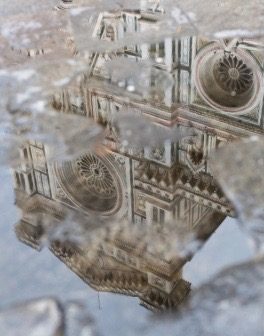
Turning from warm summer breezes in the shade, to cool gray rains, the fall season clearly was approaching. Winter wouldn’t be far behind. We were grateful to be staying in a friend’s small unused apartment in Florence, just across the Arno river, with easy access to the historic center—a delightful 10 minute walk. We enjoyed being in a different part of the city, which offered us new perspectives.

We had stayed in many different places over the past four years as we waited for the long-delayed completion of our dream-studio in the nearby Florentine countryside. Our romantically naïve plan was to run off together to a peaceful place of inspiration, leaving behind the often hectic pace of the Silicon Valley. The Tuscan hills beckoned.

Awesome view

We imagined ourselves living a simple life in nature with just the bare necessities—a small stone one room studio with an awesome view, where we could write stories and music about our experiences of life in Italy. We planned to share heartfelt conversations in front of an old open Tuscan fireplace, while sipping on hot mugs of coffee—dreaming, creating, spinning story and song into contemporary fables and fairytales that could actually come true. Still very much in love after nearly 30 years together, we were up for the challenge of taking our relationship to the next level, whatever that meant—longing to find out.

We decided to recommit

The message of another delay in the project arrived on that cold rainy day, and we felt our patience fray. Frustrated and deeply saddened by the thought of yet another problem, we actually considered ending the project. Just call it quits. As we talked it over, though, the vision slowly started coming back into view. We reminisced about our feelings and desires that led to this dream in the first place. We found ourselves re-engaging, breathing new life into our intentions. Determination and commitment rallied to fill in the gaps as we took a collective deep breath. Looking into each other’s eyes, we both felt a shared resolve.The answer: the dream must continue. The strength of our partnership literally rose-up in that moment of need to protect our fragile possibilities.

As is our custom, we turned to music and story to sort out the jumble of feelings we were experiencing—the hope, love and appreciation for both the challenges and successes. We decided to write a song to commemorate that time as if we were getting married again—recommitting to our shared vision, the romantic dream, the Tuscan studio. It became a  ceremony of rebirth (Renaissance) in our little borrowed home in Florence.

Music can sort things out

Friends Patrizia and Virginio dropped by for an unexpected visit later that evening. We had just finished a rough version of the song, and decided to sing it for them. They quietly listened as we stumbled through our newly penned lyrics and still-settling melody. Little did we know, that song would became the touchstone for this journey of the heart. We were delighted to share that moment of celebration and hope with them as they unknowingly became silent partners in our autumn sojourn.

On that cold, damp fall night, we did exactly what our hearts desired, fulfilling the essence of our shared dream. We vowed an Uncommon Promise to one another, knowing that it would be strong enough to carry us through—whatever was to come!

Music

Uncommon Promise

Here’s the song we wrote nearly 20 years ago to commemorate that turning point—commitment no matter what! It remains a touchstone for our relationship to this day. The name is as you might expect, “Uncommon Promise.”

Note: This post became the first to be recreated into a podcast with additional commentary, also under the name of “Uncommon Promise.”

Not every bridge is famous.

But that doesn’t mean they aren’t all equally important. In fact, the smaller they get, the more “pedestrian” they become, and in some ways, more important. Why? Because they make a real difference for local people in their every-day lives. Neighborhood bridges get built because individuals make it a priority, teaming up to create change on behalf of a community. Shared necessity. Common Good. That’s a beautiful thing!

San Diego has always been at the heart of local bridge-building. When you create a city on top of many canyons, spans become a priority. Following are some examples of local bridges that emerged out of ingenuity, persistence and community action, linking areas or locations that would otherwise be forever split apart. Bridging becomes a sacred human act. Following are three very different examples to consider:

First Avenue Bridge

Looking up from Maple Canyon.

Bottoms-up

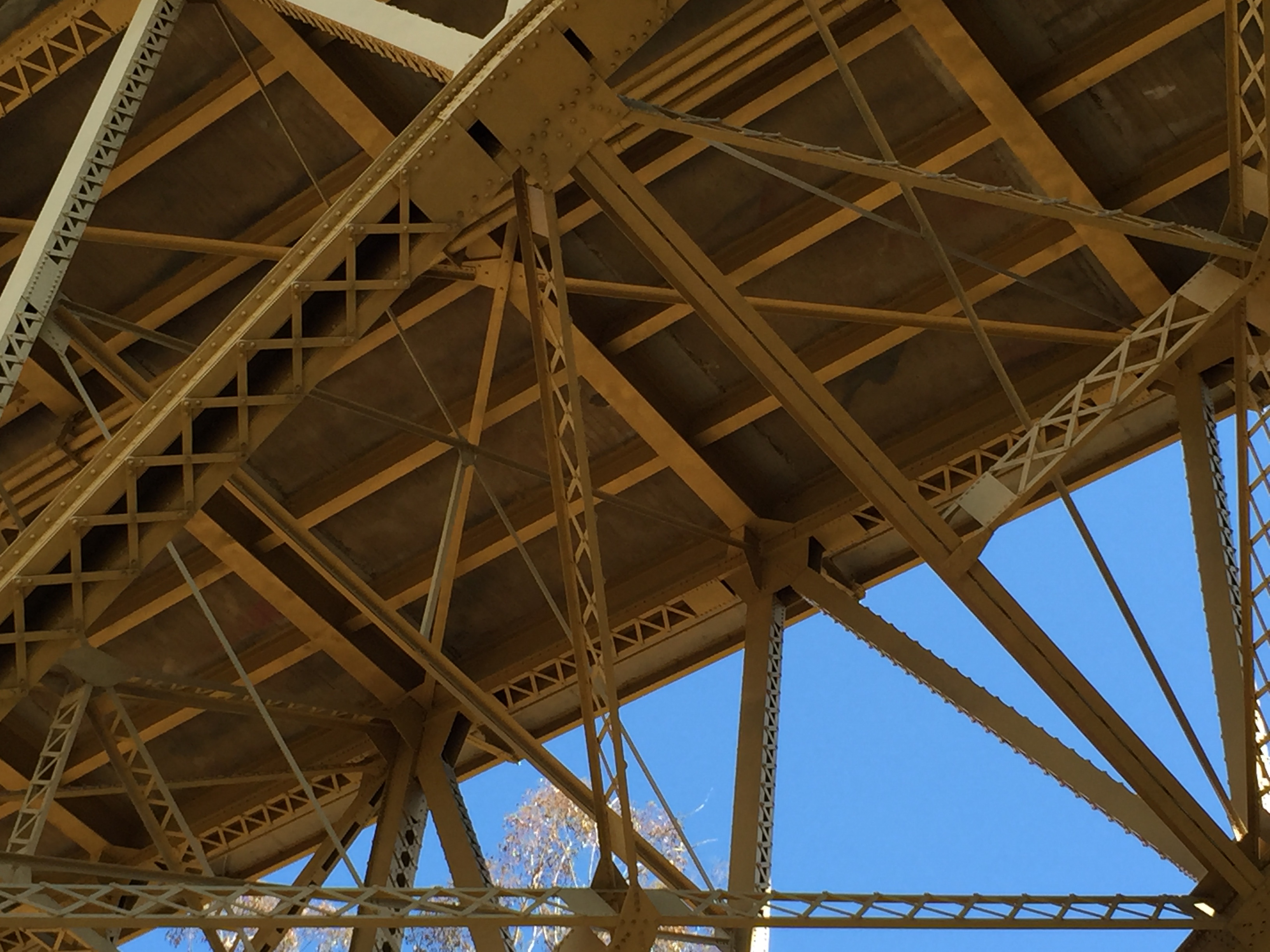
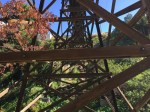
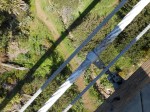
The best place to observe the vehicular/pedestrian First Avenue Bridge is not on top, but rather, from below. Take the canyon trail down to the bottom. Wow! What a gorge! To go from one side of the canyon to the other would be quite a trek. Obviously a bridge was needed to connect the two sides. The canyon was actually disrupting the natural flow of everyday life, separating neighbors from one another. So the locals petitioned the city to construct it in the first place.
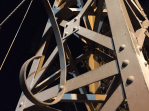
From below, you can see the result of their request—a beautiful steel lattice structure spanning the gap.

The FIRST, First Avenue Bridge

Here, you’re looking at the original “People’s Bridge,” a modest span to meet the need, built in 1911 as a relatively quick and light-weight solution to the problem. It definitely worked for 20 years. Then, it was time to get serious, so the test-bridge was replaced with the permanent version—the one we know today. The crossing was here to stay, and that was a huge victory! 

So now, we actually have the new improved version of that 1931 replacement bridge. It has become part of the historic fabric of the city, deserving a $12.7 million make-over. It was completely restored in 2010 to it’s original color and details, looking pretty much like it did when first completed some 90 years ago.

American Sampler

This restored edition of the bridge is truly a piece of Americana. It’s a great example of a steel arch bridge from the early 1900s—the only one in San Diego, and one of only a few left in California. Structurally, it includes about every trick in the book—a real “sampler” of 20th century steel construction. All of the pieces were made and then completely assembled on the floor of a midwestern fabrication plant, then dismantled for shipment to San Diego where it was reconstructed as it is today. The bridge is 463 feet long, 104 feet high and carries nearly 10,000 vehicles daily, linking both sides of the canyon—an essential connector! 

Thanks to the many efforts of the local people, the First Avenue Bridge has become not only a time-saver, but also a money-maker and will hopefully remain an important San Diego landmark for many years to come. Power to the People!

Quince Street Trestle Bridge

Quince Street Trestle

How pedestrian!

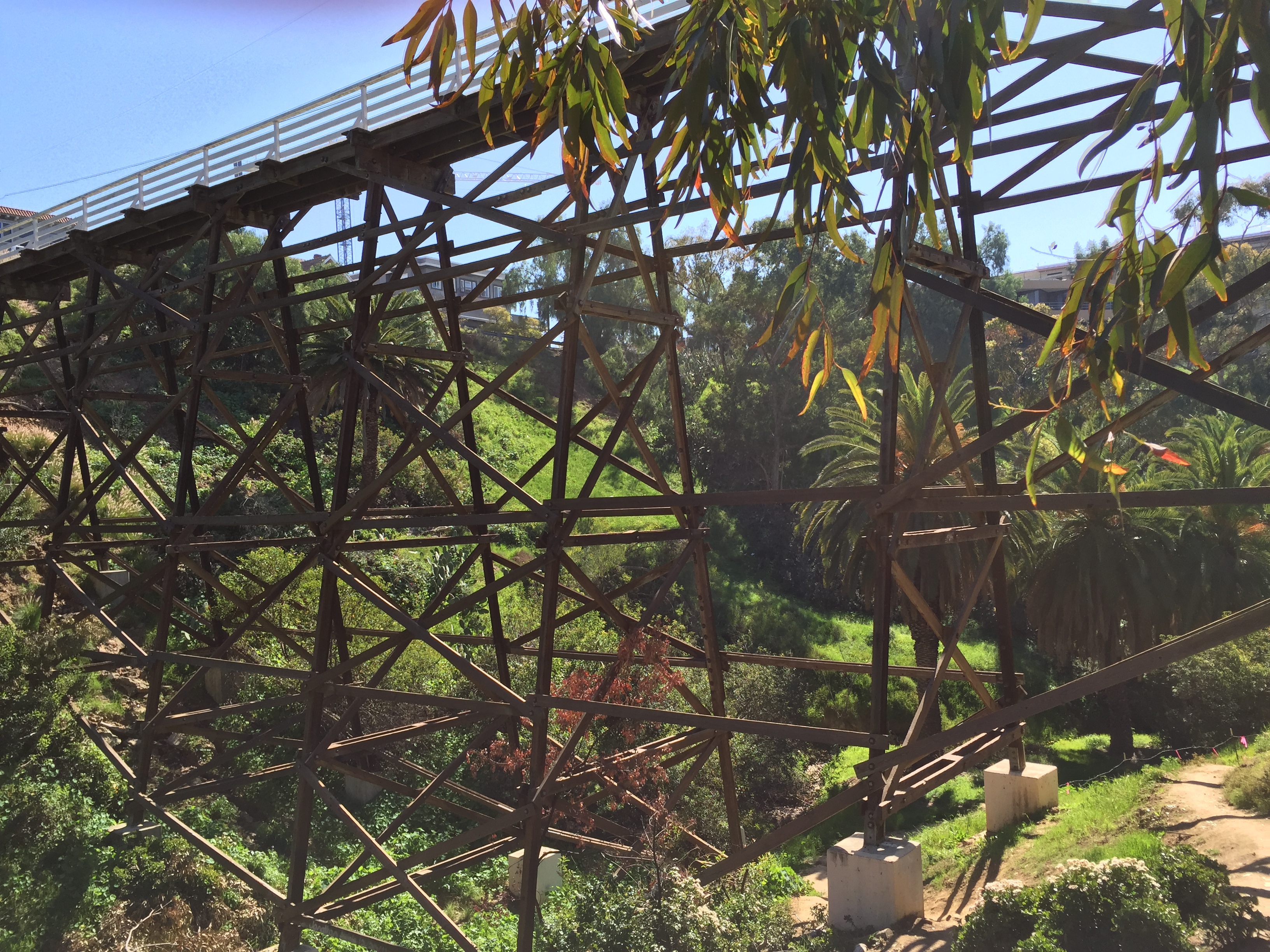
The Quince Street footbridge crossing is one of the few wooden trestle bridges left in San Diego, and it’s a beauty! Originally constructed in 1905 and designed by a city engineer and local resident, George d’Hemecourt, this bridge allowed residents long-awaited access to the Fourth Avenue trolly line—spanning 236 feet at 60 feet above the canyon floor. 

This bridge is also testimony to the power of the local people. After suffering years of damage to the wood structure and eventual collapse at one end, it was permanently closed and slated for demolition. That’s when resident Elinor Meadows led the way to have the structure designated a city landmark due to its unique construction. She persevered to victory in 1987 as the city finally agreed that it was an important part of the fabric and history of the city. After more than two years and $250,000, it reopened in August of 1990—revived, rehabilitated and ready to serve a new era of San Diegans.  

Spruce Street Suspension Bridge

Suspended in time

A bridge so special, it has at least three names.

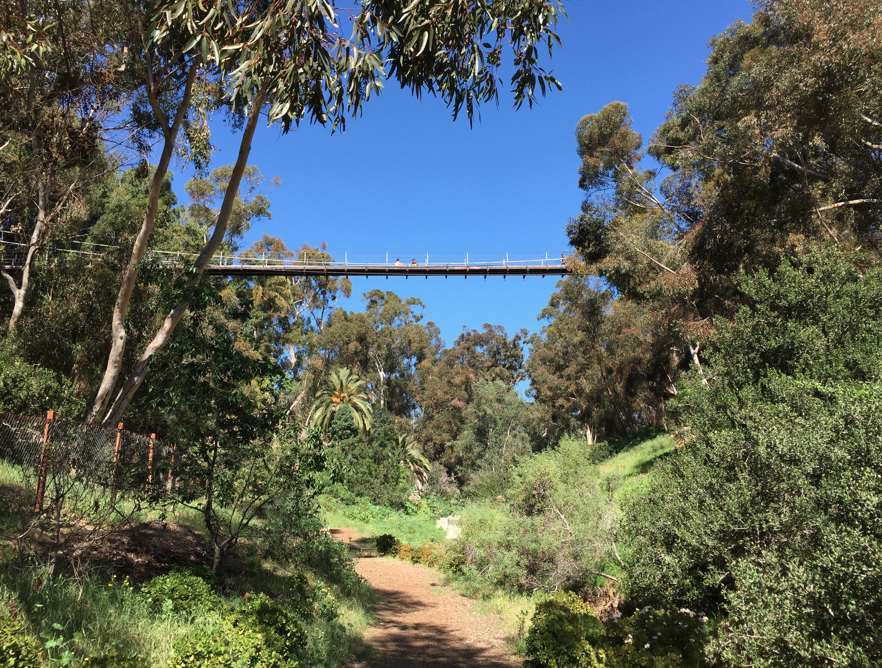
This pedestrian bridge is so magical that it’s location defies naming. Some say it spans “Kate Sessions Canyon,” named after the revered San Diego horticulturalist. However, you can also find the trail under the bridge described as “Spruce Canyon Trail.” Or, you can find a sign declaring it to be “Arroyo Canyon.” For our purposes, we’ll just call it the “Suspension Bridge Canyon.” We will leave the definitive naming of its exact location “suspended” in time, just like the beautiful bridge.

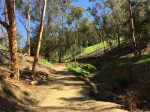
Lay down on the canyon floor and observe the gentle motion of the bridge as it sways back and forth with a slow cool breeze. People find dangling their legs over the sides irresistible, letting themselves be lulled into a sort of twilight sleep by its gentle rocking. Ponder the simplicity of its design as it unobtrusively stretches across the canyon. Next, go up on top—it’s your turn!

Climb aboard

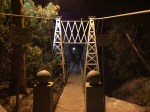
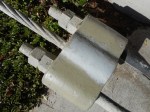
The entrances are especially nice with the mature landscaping closing in around the steel cables. It makes it even more inviting and further accentuates the “secret” feeling you get when walking up to it—compelling. Pause for a minute before stepping out onto the wiggling walkway to notice the structure: the size of the cables, the towers and the connectors anchoring into the concrete—substantial and unique, surely one of the first “moving walkways” in the US? 

So there you have it—three very different bridges that all do their jobs exceptionally well: all are functional, unique and grew from the needs of real people with local lives to live. Each one connects point A to point B, yet, creatively solving the problem in a very specific way. They bear the names of real people associated with them, those who cared enough to take action. Because of these bridges, we’re all a little bit closer to each other; more connected in unseen ways; a little bit better than we surely would be without them—bridging the gaps of our lives—bringing us together! 

For a pedestrian experience of a different kind, you might enjoy a related post about an incredible hike that meanders around the city of Florence Italy—fantastic views from the surrounding mountains and valleys. The story is called “Renaissance Ring.”

Wow! How did this happen?

Last night we watched “The World’s a Little Blurry,” documenting the meteoric rise of the American singer-songwriter Billie Eilish, whose actual name is Billie Eilish Pirate Baird O’Connell. In 2015, at the age of 14 she decided to record the song “Ocean Eyes” written by her brother Finneas. Then just for fun, she posted the song on SoundCloud. Almost instantly, she was acknowledged with 10 million hits and her career was launched. Then in 2020 she won five Grammys. That same year Forbes reported that she had an estimated net worth upwards of $50 million, even before the release of her documentary-style movie.

Like many creatives, she expresses herself not only in her art, but also in her appearance. You can’t help but notice her brightly colored hair, baggy eclectic clothing and jewelry—lots of jewelry. She was born and raised in Los Angeles. Billie and Finneas were encouraged to be unique, creative and expressive. But LA and and the US are full of talented people. So we wonder, “Why Billie? How in the world did this success happen for her?” 

Gen Z

Billie belongs to Generation Z, sometimes called Zoomers. In fact, she’s one of the charter members of that group—nearly 68 million strong in the US. The general characteristics of this “selfie-generation” according to experts, is that they’re completely comfortable in a digital world, entrepreneurial, and insistent about diversity. They’re mostly unaffiliated with religion, and generally less rigid—blurring traditional “lines,” which results in being very progressive and individualistic.

Reach out and touch someone

But, lurking beyond this seemingly unlimited potential is a blaring contradiction. Although they may be quite connected via technology, they seem overwhelmed with life in general, somewhat lonely and depressed. Why? Of course they exhibit the same needs as every previous generation. Everybody wants love, significance, meaning, and belonging, right?  But the Zoomers have the added overlay of the extreme complexity of today’s world. Imagine being a Gen Z whose reality is constantly changing with rapid-fire high-tech information, coupled with an immediacy of communication and potential influence in the world. In this case, writing a song is daunting and the recording process is another task altogether. Then, and only then comes the marketing, right? No! Gen Z’ers write, record and upload all within days or even hours—the entire world is at their fingertips!

Finneas creating music at home in the bedroom studio

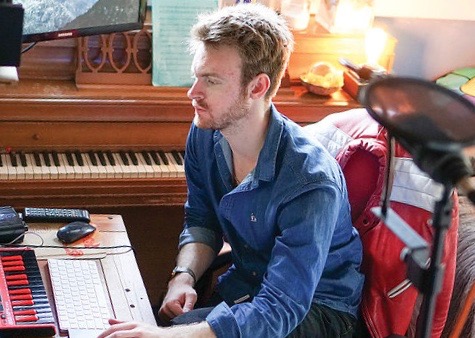
In a way, it all makes perfect sense. Think about it: young Billie is highly charged in a creative environment at home. She considers many different directions for her life, but is naturally drawn to the freedom and expressivity of music which is already a familiar part of her home-life. She adores her older brother Finneas and they develop a collaborative style of writing and producing music together in their bedroom studio. Being spontaneous and comfortable with social media, she probably had no hint of hesitation about putting their first song out on the airwaves.

Billie with her adoring fans

Nearly 70 million young people are listening for words and sounds that reflect how they think and feel about their place in this world. They’re not looking for answers, but rather, a voice that’s poetically and romantically asking their own personal questions. Billie projects a dark but playfully creative persona that resonates with them. Just imagine hearing her music for the first time. Perhaps feeling an immediate resonance, each listener forwards it on to several friends, inviting them, “Listen to this! You won’t believe it. She’s like me. She feels the way I do. She sees me!”

Like magic, suddenly everyone knows and loves Billie Eilish and can’t get enough of her personalized musical view of and from the Gen Z perspective. Creating a musical narrative of her life is just Billie doing exactly what she loves to do with her best friend/brother, all the while being coached and encouraged by loving parents.

Sizzling spark of energy

Billie Eilish is the classic electrical spark, the confluence of powerful forces at play—the right person at the right place on the right platform at the right time. Boom!

There’s really little reason to wonder how or why Billie Eilish became a phenomenon. Her passion is that she speaks (or sings) from the heart on behalf of millions. To quote philosopher, Joseph Campbell, “Follow your bliss.” Seems that Billie’s bliss is both magnetic and magical.

Fogged in

We awakened to a gray morning in the valley with fog just outside the window so thick you could see it hanging in clumps. Cheryl turned to me and said “Come stai oggi, how are you today?” “Sto male, I’m not well,” I said with a coarseness in my voice. It seemed that my sinus condition had worsened in the night and had reached a critical point. It was clearly time to see Francesco, our local pharmacist to ask what could be done for my deteriorating condition. 

We got dressed and went downstairs, and as was our custom, we flipped through the Italian dictionary to make sure that we had all of the words we needed to get right to the point. This was not the time for a miscue in communication—say it right one time, get some medicine, and then back home into bed.

Feeling well-prepared for the conversation, we got in the car and Cheryl drove us to Fiesole, the nearest town, where we hoped the pharmacy would be open. (We’ve been told by many shop owners that they are ALWAYS open, unless they’re not.)  I went in while Cheryl kept watch with the car, illegally parked on the sidewalk out front (that’s normal). To my dismay, Francesco wasn’t there, so I had to explain my condition to his associate/pharmacist I had never met before. I thought to myself, “My issue is rather simple and fairly common so it shouldn’t be a problem. With the season change, surely sinus issues are addressed daily.” With my confidence bolstered due to my self-reflection and recent language lesson brush-up, I approached the counter and stated my case. 

I’ll never forget that look!

I began my explanation in a pleading tone befitting someone not feeling well. I said, “Ho un’infezione nel mio seno, I have an infection in my sinus.” The look on the pharmacist’s face was one of both astonishment and confusion. Checking for possible errors, she cautiously asked me to repeat what I had just said, and so I did—loudly enough for everyone in line behind me to hear. Each customer was suddenly privy to the personal details of my condition. She then repeated it back to me in a questioning tone, with a look of slight repulsion, she began pointing to her breasts. What!?

My new best friends

Now, this really confused me. At first, as unbelievable as it may seem, I thought there was an outside chance she was hitting on me. Was I delirious? Surely, in my condition and in the pharmacy line, of all places, this could not be the case. Then, I instinctively pointed to my nose. Instantly, she was relieved about our seemingly imminent first date, and the issue was suddenly clear. There was an almost audible sigh of empathetic relief from all of my “new best friends” behind me. I turned and offered a polite but awkward smile. The pharmacist quickly prepared an appropriate remedy. I paid her in cash and gathered my gift-wrapped package (they sometimes do that in Italy and we have no idea why). I shuffled through the door, breathing a raspy sigh of relief, eager to begin administering my new healing regimen.

As I approached the car, I detected a look of embarrassed concern on Cheryl’s face. It seems that while I was inside the pharmacy, she was outside, practicing her reading skills. There was a large poster in the pharmacy window advertising a cream for breast enhancement. She had spotted the word seno and knew that I was inside at that very moment, asking for some help with my seno. Oooff. She knew before I did that, depending on the context, the word seno is unfortunately, the same for both sinus and breast (why oh why would they do that?) With 450,000 words in the Italian language, evidently, they couldn’t add one more? There was no pronunciation or even a grammar error this time. 

I’ll do better next time

To this day, I’m still troubled by the incident. Why, given the two choices between sinus or breast, did the pharmacist think that I meant breast, since I am obviously a man (I did though, at that very moment question my own masculinity). I was sure she could clearly hear the raspy nasal tone in my voice that indicated a sinus infection. Maybe I inadvertently placed my hand on my chest, giving her the wrong visual cue.

So from that day forward, I’m extremely careful to make sure my hand gestures are tightly synchronized with what I’m trying to say—just like any good Italian!

This is the first “breadcrumb” we’re leaving along the path “Toward the Light” of aging.

Rumi speaks to us across seven centuries, as a wise old friend joining us in the shade of the porch on a warm summer afternoon. Perhaps he has come to stay for a few days, or even longer. Wonderful! We sit entranced by his soothing voice as he recites a poem written especially for us. He calls it “The Guest House,” to honor our openness, hospitality, willingness to listen and our love of Life. We absolutely adore his visits—always gentle, kind and gracious. We heed every carefully selected word and subtle inflection in his voice as he begins:

This being human is a guest house.
Every morning a new arrival.

A joy, a depression, a meanness,
some momentary awareness comes
As an unexpected visitor.

Welcome and entertain them all!
Even if they’re a crowd of sorrows,
who violently sweep your house
empty of its furniture,
still treat each guest honorably. 
He may be clearing you out
for some new delight. 

The dark thought, the shame, the malice,
meet them at the door laughing,
and invite them in.

Be grateful for whoever comes,
because each has been sent
as a guide from beyond.

What a beautiful poem to start our journey into the “final stage of life.” We took our first step by cracking open “The Spirituality of Age: A Seeker’s guide to growing older.” The co-authors invite readers to take a new perspective, a new vision toward aging—with a veil of spirituality. Count us in!

Rumi, our first guest

As we all know, in order to begin any new endeavor, we must first be open to listen and then to actually hear. Lao Tsu said, “When the student is ready, the teacher appears.” Hmm. Ahh. We are ready, and Rumi arrives as our first guest and guide. We lean forward to hear his message. Shhh!

Poetry by Rumi, from “The Essential Rumi,” translated by Coleman Barks.
The Spirituality of Age: A Seeker’s guide to growing older,” by Robert L. Weber Ph.D. and Carol Orsborn, Ph.D.

The first post of this series is called “From Wind-Down to Wisdom,” and can be found with a simple click. To find all of the stories that will follow, just enter the word “Breadcrumbs” into the Stories “Secret Search” box,” on the site’s front page and they will all magically appear for you.

Turning toward the Light.

Cheryl’s mom had a funny saying, “One day, we’re all going to wake-up dead.” This may sound like a contradiction, but it’s actually a humorous nod to an inevitable reality. 

Kane Tanaka

Hey folks, that’s the truth of the matter. We all WILL die, even though some people seem to defy that reality. For example, the oldest person living (as of Jan 12, 2021) is Kane Tanaka in Fukuoka, Japan—born the same year as the Wright brothers’ first powered flight. Imagine that! For some of us, the earthly end will arrive much sooner than it will for others, but eventually, even Kane will take flight. But at 118 years, she wants to delay her own “take-off.” She thinks she’ll be ready when she’s 120. Why is that any better than 118, you might ask? Only Kane knows?

So, what’s her secret to longevity? She says it’s all about “Eating delicious food and studying,” Okay, we can do that, but frankly, there must be a bit more to consider!

Living well is one desire that many of us surely share. However, for some, the topic of mortality has rapidly moved to the top of the list. We represent just two Baby-Boomers, two septuagenarians. But let’s face it, In order to even consider a powerful “lift-off” from this earthly adventure, it makes sense to examine our pasts—which may then require a little clean-up work. We’ve always tried to “keep house” as we go, checking in with the expertise and wisdom of select therapists along the way. But, over the past several years we’ve decided to “up our game,” deliberately and methodically digging into lingering issues or limiting perspectives. We feel that this deeper dive will help better prepare the Way. Now, together, we are ready to design a “grand finale” for this human experiment. Here we go!

Erik Erikson

We first shifted our gaze to the future when our wonderful therapist Dr. Jody Saltzman referenced the work of the German-American psychologist Erik Erikson. He authored the now famous “Eight Stages of Psychosocial Development”—of which the last and final stage is “Maturity” (from ages 65 to death). Ooff! That last hurrah has also been referred to as the phase of “disintegration.” YIKES! That doesn’t sound good! However, upon further study, the “virtue” of that stage, according to Erikson, is “wisdom.” Hmm. We became intrigued and decided to check that out!

We are stardust

We began our own little research project to uncover the possibilities that lay ahead. We strongly preferred the word “transformation” rather than the ooky term, “disintegration.” Oh, sure, we know about the “ashes to ashes and dust to dust” thing, but disintegration sort of signals a painful “falling apart.” No, thanks. So, our mission is to turn this time in our life from “the beginning of the end” to just “the beginning.” With thoughtful enthusiasm, we jumped right in. 

Once we decided to explore the topic, we found ourselves sorting through some amazing information. It will definitely take some time, determination and patience, but early indications suggest that irresistible clues are scattered all around us. Transformation is not only possible, but appears to be the preferable “calling” at this juncture.

Finding our Way

Mind you, our interest is certainly not about “staying young,” (too late for that) but rather about making the most of this truly once-in-a-lifetime chance to “grow old and get wise.” We also suspect there might be others who are approaching similar crossroads. So, as we meander and stumble our way along this trail, we will drop as many breadcrumbs as we can. Perhaps, as we follow the clues left by those before us, we too can find our Way “Home.”

We’ll keep you posted!
Cheryl and Emerson—fellow travelers

This initial post will be followed by an ongoing series called “Breadcrumbs.” To find the complete list of entries to date, just enter “Breadcrumbs” into the Stories “Secret Search” box, and they will all magically appear.

You might also check out our related music and story from 2008 called “Toward the Light.”


My body felt like lead. “Who are you? What do you want.”

Somewhere in the stillness of the night, I became aware that I was dreaming. Or was I?

Okay. I’ll admit it. I had a really tough day! A good night’s rest is often the best remedy when the “toughness” sets in, so we hit the hay before the clock even turned to double digits—which is really early for us. We usually see every double digit, and witness single digits again before calling it a day.

I was sure that sleep would offer me an escape from the day’s stresses—at least I hoped so. Usually deep and satisfying sleep is often a refuge. This night began with promise, but shifted abruptly shortly after drifting off. I steadied my breathing and remember the sensation of falling asleep and releasing the day’s worries. I was right on track in the beginning. I shifted my weight to the far side of the bed to give Cheryl and our little doxy Sara more space. I was hovering in twilight sleep.Then suddenly I wasn’t!  

Fast asleep

My nightmare began. I dreamed I was asleep in a long narrow room totally unfamiliar to me. All alone on a skinny single bed, I was peacefully slumbering, laying close to the far corner of the room opposite the door. Suddenly, the door opened and someone or something entered. In the darkness with dim shadows I saw it silently moving toward me. It was a pale creature, formless, yet weighty. Startled, I had the urge to wake myself from this terrifying encounter. I tried to sit up, but couldn’t move either my legs or arms. They felt like lead. Still groggy, I called out, “Who is it and what do you want?” But my voice was as frozen as my arms and legs. From my lips I heard a low guttural, creepy sound something like: “Bhough eez zhit ehhhh bwaht zhou whwanndt?” Needless to say, there was no response from the silent intruder. I struggled again to get up and confront whatever it was, but it just kept floating/sweeping toward me as if sadistically enjoying my night-time terror.

The “Entity”

The “Entity” swooped low at the foot of the bed, then circled around me moving ever-faster. Then it approached the corner of the bed close to my head. I could feel an icy cold air following its movement. I tried again and again to simply turn my neck to see it more closely, but all efforts were in vain. I absolutely could not. It sensed my growing fear and somehow hovered both behind and beneath me. Dimensions and depth blurred. In a fit of desperation, I mustered every ounce of strength, flailing in the air with my hands over my head trying to disrupt its sinister plan. In my last best hope, I took one great vanquishing swipe into the darkness.

I was jarred into semi-consciousness with the sound of a heavy steel lamp crashing onto the wood floor. I bolted upright, disoriented. At that point, the bright ceiling light came on, blinding me. Suddenly Iris was up and on high alert. She was awakened by the crash, but of course, the “Entity,” was nowhere to be found. The only source for the sound clearly fell to me. Boy, did I ever feel ridiculous!

At breakfast we gathered around the table to review the night’s events. I told Cheryl the sordid details of the intruder’s attack. Always objective and curious about dream symbolism, she matter-of-factly said that the “Something-Entity” may have represented my “Shadow” coming to challenge me. Would I control it or would it control me? My response was the same as always, to fight back. That is my fatal mistake, it seems. To disown the shadow sets up battle lines, as a war ensues that can never be won—by anyone. And, once again, I sadly end up attacking and destroying my own “LIGHT.”

Integration

Perhaps this little night-time vignette has finally made it clear. The only way for the LIGHT to prevail, is to INTEGRATE with the shadow. The power of the shadow is in its ability to provoke. If I’m not provoked, perhaps it will settle down. “Wholeness” is the only viable strategy. I finally got it! Then, I walked into town to the hardware store to get the necessary supplies to fix the broken table lamp.

Moral of the story: Rest assured, the LIGHT always wins in the end—eventually! Why not just let it happen sooner, rather than later?