
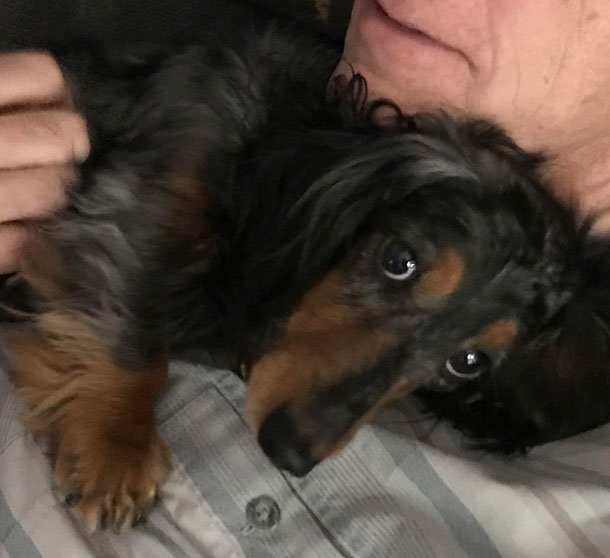
You’ve probably heard of the dog breed called the Blue Heeler. Well, our experience tells us that most dogs are amazing healers of a different kind.

Anyone who has ever had a dog can probably attest to the fact that canines, as well as other different pets, seem to have a sixth sense. It’s a multifaceted and magical capability that goes beyond empathy, love and loyalty to include powerful “healing.” Yes, that’s a big statement, but it’s true—dogs are “Mystical Doctors” rather than “medical doctors.”
For example, our little 9-pound doxy is a profound Healer. We’ve had many dogs over the years, each with a unique personality and special talents, but none have been quite like our little Sara. She seems to be hard-wired to heal.
If one of us is having a sad or down moment, she seems to single the “patient” out, making physical contact her top priority. She’s always focused on the one in need, leaving the capable other to fend for themselves until her healing is done. It’s as if she’s a sponge, spontaneously drawn to soak up the sad or wounded energy. We joke about the magical capabilities, by calling the process, “fur-therapy.” She thinks it’s just “being a dog.”

In these pandemic days of video medical appointments and tele-therapy, she insists on laying on the needy lap—a circle-dog all curled-up to provide optimal care. Time and energy are unimportant to Sara. She’s there for the duration, taking in the stress while imparting warmth and comfort.
Recently, Em had a tele-therapy session and Sara assumed her normal healing position in his lap. Then, as Em became agitated, Sara suddenly began to shiver. She seemed uncontrollably cold, which is odd given that it’s summer in California and human laps are typically especially warm. Em noted her strange behavior. The session ended rather abruptly due to his intense emotional reaction. What did Sara sense?
Following the session, Em lay on the bed to regain his balance. Normally, Sara would assume her familiar conditioned position on his lap to snooze. But she behaved differently. She refused to sleep and instead, she turned away from him and laid down at the foot of the bed. He called and coaxed her to come to him, but she completely ignored his requests and, in fact, wouldn’t even look at him.
Then Em noticed something he’d never seen before. Sara continued shaking, but now it didn’t seem that she was cold. Instead, It looked like she was shaking to throw off the negative energy she had absorbed from him. Our conclusion was that his negative mood had been too much for her. She had reached overload! Apparently she was just too maxed-out and couldn’t convert the bad energy to good. Furthermore, she refused to come anywhere near him for the rest of the evening.
The following day, Em regained perspective and equilibrium and Sara couldn’t get enough of him. Perhaps she deemed the remaining energy work to be possible. Or maybe he was feeling so much better she just wanted to soak-up some of that positive energy. In any case, her presence was sorely needed and made all the difference in his day of recovery.
This story is an anecdotal, intuitive recollection of “a day in the life with Sara.” There’s nothing scientific or measurable. However, when you find yourself in need of some therapy, rather than asking, “Is there a doctor in the house?”, why not consider fur-therapy. Simply ask, “Is there a dachshund in the house?” We think someone will answer the call and come running.

An addendum: As usual for a weekend, we went to get coffee at one of our favorite coffee bars. A woman sitting next to us, noticed Sara and turned toward her. We introduced Sara and the lady smiled and asked to pet her. Then, she requested, “May I hold her?” We gently handed over all 9 pounds of Sara and she was immediately comfortable with the stranger. Then we glanced at the woman’s face to see that tears were streaming down her cheeks. She said, “You have no idea how much I needed this love, thank you sooo much!” Sara responded with a couple of quick licks—which always means, “You’re welcome.”
Related Story and Music

Sara’s older half-sister Isabella (Izzi-B) was our previous “Mystical Doctor,” hanging a shingle outside our home for 16 years. She later became a well-known Italian personality after many adventures in Tuscany. The following story called “Isabella” was written for her in 2013 and we share it now in her loving memory.






































 Quality time is undeniably great for relationships. We've discovered that quantity of time can provide that quality. Perhaps it takes Time to Partner.
 Uncommon promise