These are stories about those places that are noteworthy either as public attractions, or perhaps even quiet personal places that make a difference in people’s lives. They are the places that give us energy, sustenance and reflective moments that help us to live richer lives.
How do we know that? Just listen! Aside from English, and of course Spanish, you’ll hear Chinese, Korean, Japanese, Cambodian, Thai, Laotian, Vietnamese and Tagalog, along with other Pacific Island and Asian languages. You’ll notice that the air is laced with spoken melodies of French, Italian, Portugese, Armenian, Persian, Greek, German, Russian, Polish, Hindi, Arabic and Hebrew. Various African words and phrases also float about, intermixed with Navajo and other Native North American languages as well. Some, of course, are more prevalent than others, but they all have their day in the California sun, and they all have their “say.”
“Soul” of the city
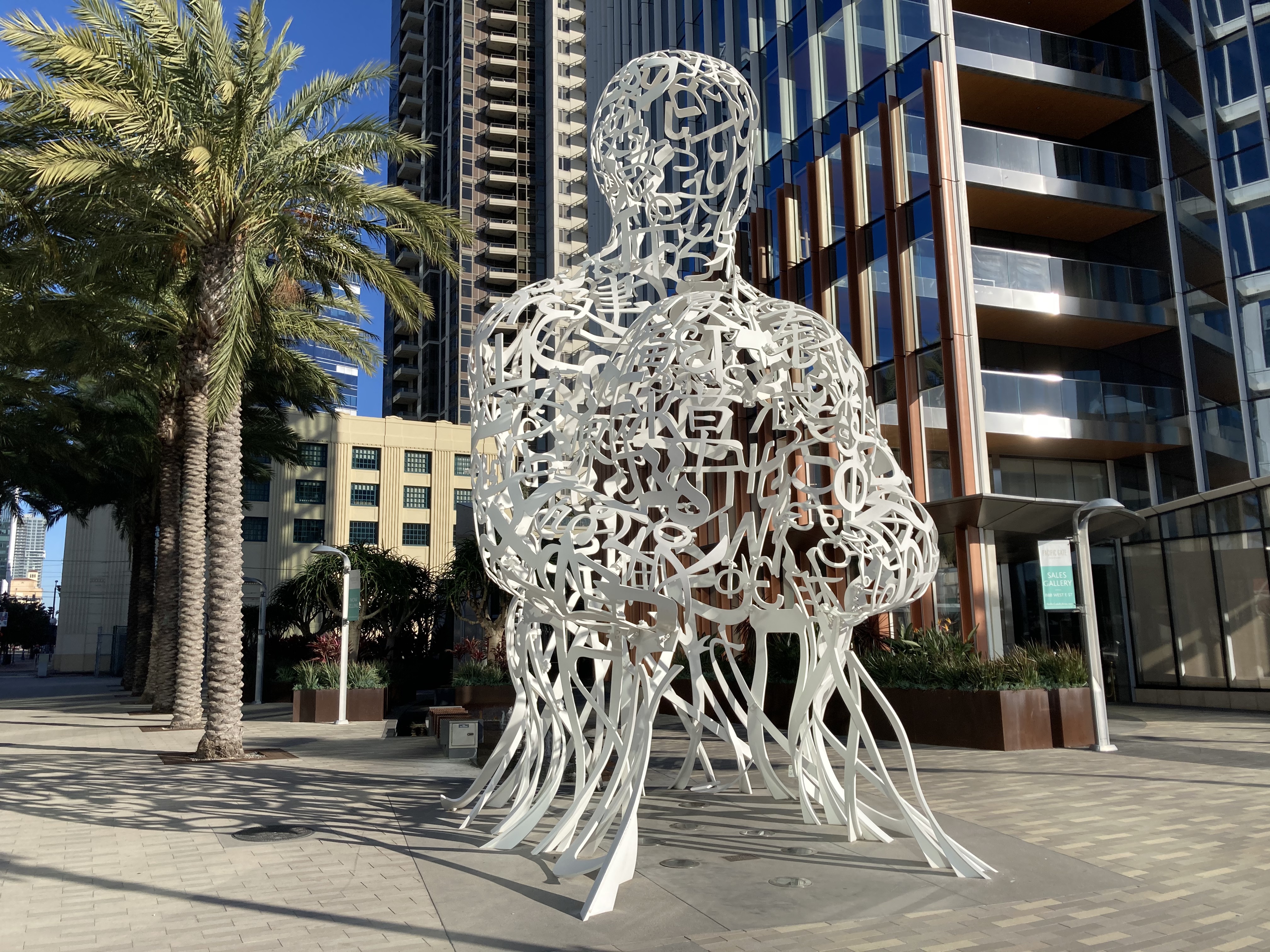
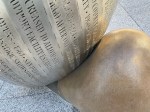
In addition to hearing the multi-cultural diversity, you can now actually see it, thanks to Jaume Plensa. He is a world-renowned sculptor from Barcelona, who has bestowed his sculpture to San Diego, representing his interpretation of the “Soul” of the city. His multi-lingual expression graces the corner of Broadway and Pacific Highway, just outside the new Pacific Gate Tower. The work is an every-day reminder of the importance of diversity in creating who we all are—together.
The human figure, titled “Pacific Soul,” appears to be crouched down, gazing west into the vastness of the Pacific Ocean. The figure seems to grasp a knee with each hand, adding tension to an otherwise serene form. About this work, Plensa explains, “The ocean is always in movement, always changing; we never know precisely where a drop of water will go, or where it has been before. It is filled with potential.” San Diego is much like its ocean companion—always changing and full of possibility. Serenity and tension co-exist.
Roots to the Pacific
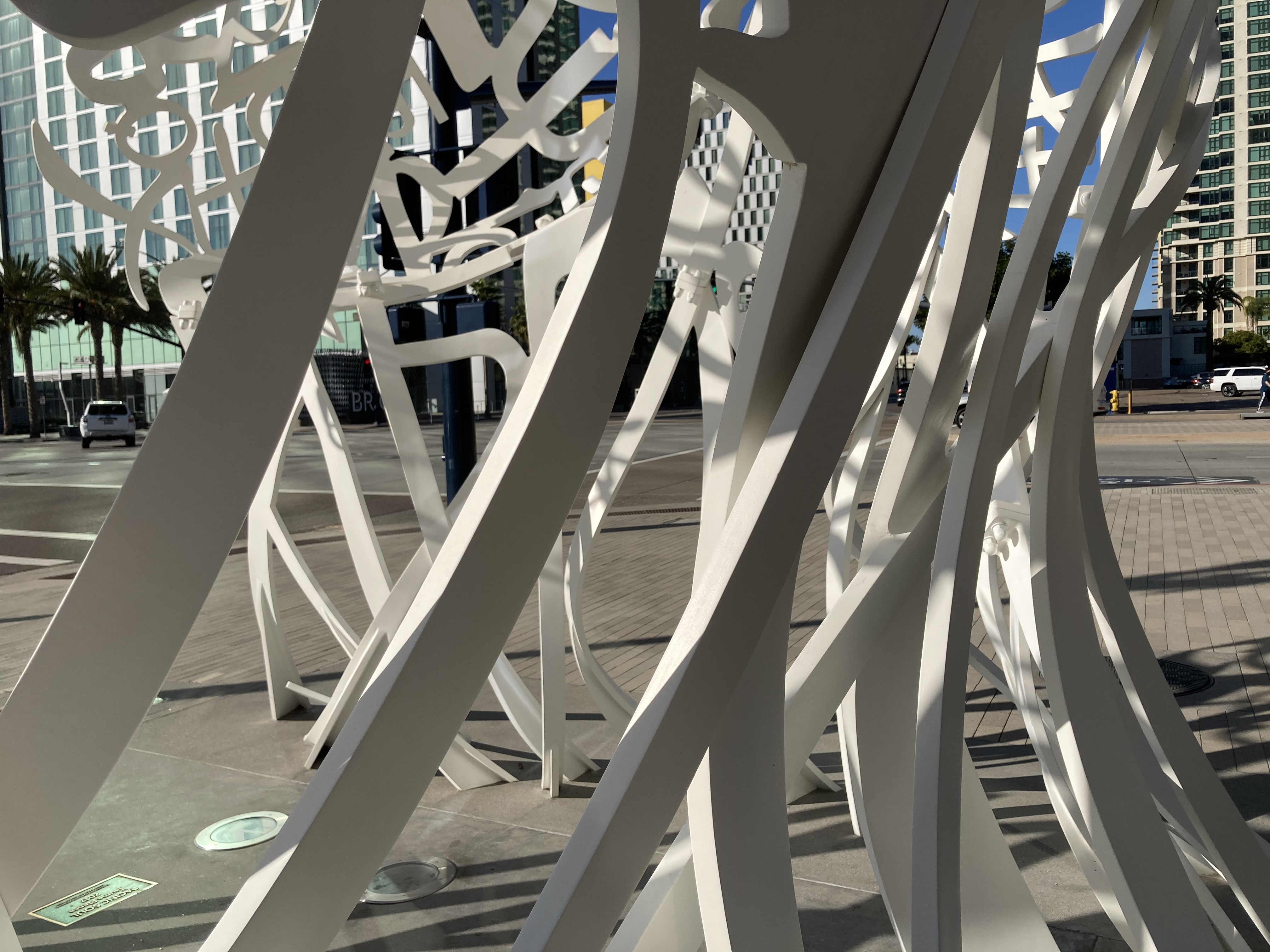
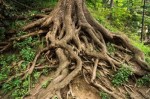
As you approach the imposing figure, you may be drawn to step inside. As you stand there, an infant in a womb, centered in the body, just imagine the magnitude of the idea—The life-giving waters of the Pacific are being drawn upward through the massive “roots” of the sculpture, giving strength and sustenance to anyone inside. We have a sense of being forever linked to the sea. As a baby is linked to its mother, we too are directly connected to the vast ocean beyond.
Looking skyward
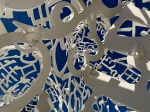
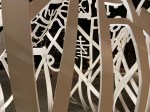
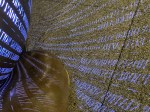
The brilliant blue sky creates stark contrast as we gaze upward. Woven together are seemingly random sweeping white ribbons and a variety of shapes. Quickly, letters come into view. These are the lines and figures that enclose us. The myriad diverse letters are gathered from many languages heard within and around the city. Words seem to float in the very air we breathe. You become, and remain an integral part of this bustling metropolis whether living here or just visiting. You can feel the ocean breeze wafting past you, like a balmy current through a screen door on a warm summer day. You are changed.
You begin to understand that your very presence makes you part of Plensa’s multi-cultural “Pacific Soul.” In addition to becoming part of the sculpture, you are also part of the unique, evolving and diverse collective we call San Diego.
Welcome!
Chinese
Latin
Hebrew
Greek
Arabic
Cyrillic
Hindi
Japanese
Tuscan Hills
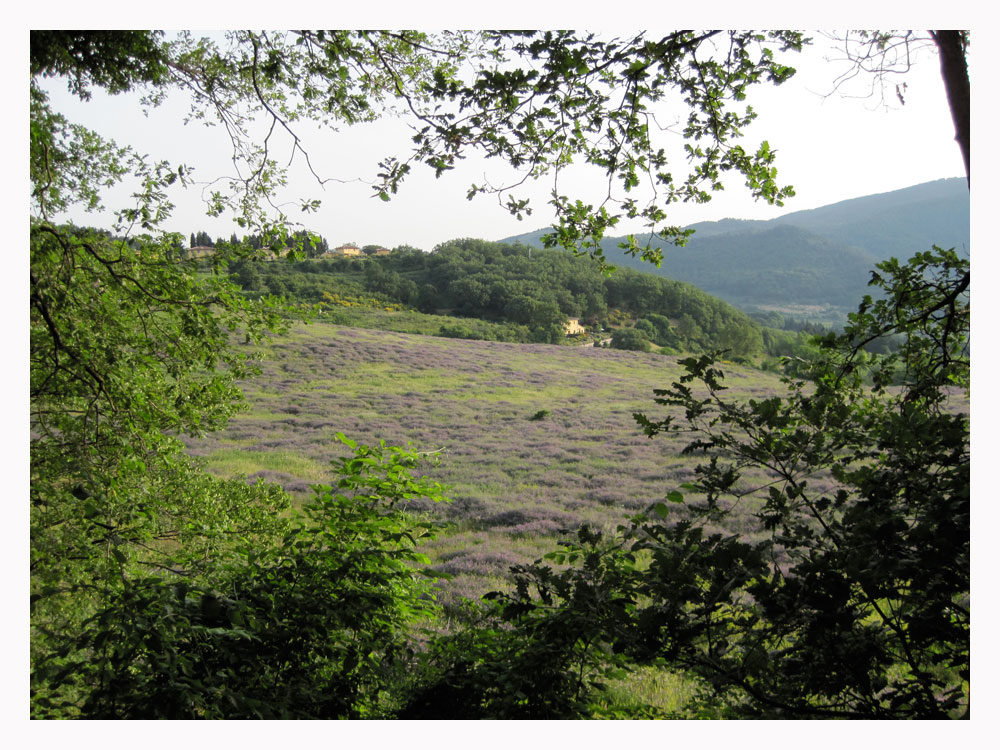
We wrote another story and song about diversity in 2011, called “Layers” that you might enjoy reading. Instead of the warm San Diego sun, we were inspired by the hills of Tuscany, where centuries layer upon each other to create a rich history and incredible landscape. That layering deepens individual lives, as well as the texture of generations, forming unmatched magical diversity.
Something happened as we drove home the other day.
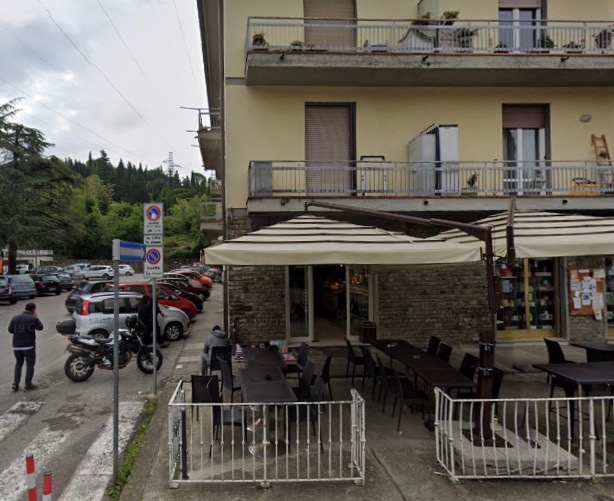
Skinniest two-way traffic in Borgunto
Returning from a routine visit into Fiesole to buy a few groceries and for Em to get a haircut, we rounded the curve just beyond the small town of Borgunto, home to the “bottle-neck capital” of Italy. To our surprise, an oncoming car flashed its headlights. It was broad daylight and we wondered, “What’s that about? Was that a friend and we just didn’t recognize their car?” A few more yards and we encountered another oncoming car. Again, headlights flashed. “What’s going on here? Is there something wrong with the car that we don’t know about?”
Lollipop police
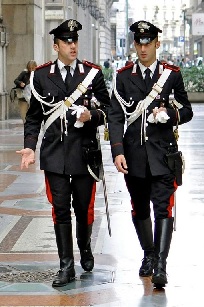
Then, just after the last turn off (and the final escape route) we saw them: Two police officers were randomly signaling cars to pull over for a routine check. Their style and flair in doing such a mundane task was actually a thing of beauty. They each wore the recognizable uniform of the Carabinieri, local police—navy blue head to toe, single-breasted blazer, silver braid around the red and white collar and cuffs, red piped epaulets on each shoulder, single red stripes down each trouser leg, a dramatic white diagonal sash, and black boots, where they store their little hand held “stop sign on a stick” when it’s not in use.
Carabinieri in action
We amuse ourselves by calling those ridiculous signaling devices “lollipops,” and so of course we refer to the historically significant and highly esteemed carabinieri as the “lollipop police.” Oh yes, they carry another piece of equipment at all times, a holstered pistol, which is classified as an “ordinary” weapon. But, as beautiful as they are, these dedicated enforcers of the law are far more than “eye candy.” They are the keepers of all things lawful.
We thought little of the request since we had all the necessary documents—title, registration, and international driver’s license—neatly stashed and at the ready in the glove box. We were seasoned “residents,” models of perfectly honest, part-time Italians with flawless organization skills. We had been randomly pulled over before, so this seemed somewhat routine. We soon discovered that it was anything but!
The rule book looked sorta like this
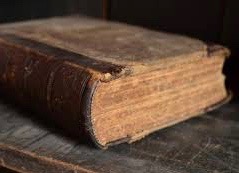
One officer strolled over to the driver’s side window, while the second remained at a safe distance, evidently serving as the back-up “protector” just in case a fight broke out. The impressive figure at the window examined the neatly stacked documents in his gloved hand, and then without a word, walked over to his colleague. Together they looked at our documents as we watched their faces change from “cool Italians” to “puzzled police officers.” Then, after several minutes, they opened the trunk of their subcompact Fiat squad car and took out a voluminous book of rules—so massive, it took both of them to pick it up. One started leafing through the pages and then turned it over to his partner, pointing to a particular place on the page. His forehead wrinkled and eyes squinted. We laughed to each other thinking that maybe we had a couple of trainees on our hands. In previous checks, the officers had only made cursory glances at the documents. These guys clearly didn’t know what they were doing—or so we thought.
The first officer returned to our car and said, “C’è un problema. Parlate italiano?” “There is a problem. Do you speak Italian?” Since our language skills were iffy at best, we said, “No.” We thought under-stating was the best strategy—they might feel sorry for us and let us go.
Sidelined—our little car given a “time-out”
Without hesitation, the officer continued his explanation in full speed Italian. We clearly understood key words like, invalido, invalid, and knew that we indeed had a problem. We just didn’t know exactly what, yet. Time to call our friend and attorney, Barbara. After about 5 seconds of hearing our explanation, she asked to speak to the officer. We heard her muffled chattering and his responses. We understood quasi niente, almost nothing. The officer handed the phone back and Barbara’s instructions were clear, “You have no chance. You must pay il multo, the fine, sulla strada, on the road. And you cannot drive la macchina, the car—ancora, again.
WHAT?!! A FINE?!! CAN’T DRIVE THE CAR?!! BUT, BUT . . .
A lot, but not nearly enough
Once we realized that we had to pay, we asked, “quanto costa, how much?” (Even tourists can ask “how much” but usually to buy souvenirs and pay the check after lunch). 275 euro was the reply, plus an additional 73 euro for something else, yet unidentified. Nearly 350 total! We asked, “How do we pay?” “In contante, in cash,” came the answer.
Okay. Let’s review.
We just received a fine of over 300 euro that must be paid in cash right now. We usually have about 40-50 euro between us on a good day. We can’t drive our car to the bank in Fiesole to get the money. Our international driver’s licenses were useless. The only choice was to ask the carabinieri to give us a ride to the bank.
The Shaq in action
At first they seem surprised, but soon realized that it was the only possible solution. So we climbed into the backseat of the subcompact Italian squad car, sequestered criminals locked in, and headed in the direction of town. One officer apologized for the inconvenience. “Mi dispiace per questo, I’m sorry for this.” Then, the other officer decided that small talk was in order, probably since they didn’t often have captive Americans on board. “Gioca pallacanestra?” We gave each other blank stares in disbelief. Then he offered in stilted English, “Bahs-keet-ball, you play?” Oh yeah . . . that question. Em is 6’5” and so it’s the single most-asked question of his entire life. (But in Italy, his height earns him the distinction of fetching top-shelf items at the grocery stores for many Italian mammas). The officer went on to say that it was his dream to play basketball—with Shaquille O’Neal. Shaq is 7’-1”. Mr Carabinieri is maybe 5’-8” in his police boots. The idea made us chuckle but we didn’t let on—B-ball talk or not, we were still in trouble with the law.
As luck would have it, the local carabinieri headquarters is directly across the street from Banca Toscana. Once out of the car, we headed into the bank before returning to finalize our paperwork at the carabinieri headquarters. Fiorella, our favorite teller saw the looks of dismay on our faces and immediately asked, “Che è successo, what happened?” We mumbled our new vocabulary words and phrases, “la macchina, multo, sulla strada, carabinieri.” She said, “Mamma mia! Quanto costa? She shook her head side to side, grimaced and offered her condolences with a deeply sincere sadness, “Mi dispiace. I’m sorry.”
Off to Driver’s Ed—Italian style
After making the report and paying the fine, we were told that neither of us could drive the car. The car documents showed that we had not done the mandatory revisione, which is the bi-annual service/safety check required by Italian law. Unfortunately, we didn’t know such a law existed. The car was to be parked until the revisione could be scheduled. In addition, they confiscated Em’s US driver’s license just for good measure, since we had resident status and were required by Italian law to have patenti italiani—the much dreaded Italian driver’s license. Oops!
So here’s the riddle: Can a car, that can’t be legally driven, arrive across town for a scheduled appointment, when driven by people who can’t drive because they don’t have valid driver’s licenses?
Answer: Maybe.
This is actually a trick question. The answer is always forse, maybe in Italy, no matter what the question is.
A friendly hello, or goodbye—you choose
The two pleasant carabinieri officers kindly returned us to our car with strict orders not to drive it—except for our immediate drive directly home (that favor required some significant begging and groveling). We were under strict orders that the car was to remain parked until we were legally able to drive it again. We promised to comply as we climbed out of the back seat of the tiny squad car. Then, in one wonderful moment of total linguistic confusion, rather than saying “Goodbye,” Mr Carabinieri extended his hand, and in an effort to close on a high note of international accord, simply said, in English, “HELLO.” Then he turned in confident military fashion and climbed back into his government-issued Fiat squad car. Their work was finished.
They surely went immediately to Riccardo‘s bar for coffee, but as for us, our “problemi“ problems had just begun!
This is a true “Italian Moments” story that took place in Fiesole Italy in the spring of 2005.
You might be interested in another kind of “Italian car story,” except this one has a happier ending—called “True Italians.”
The Espresso experience is so much more than drinking a cup of coffee.
Of course the ultimate espresso can only be found in Italy. Case closed. Nothing can match the total experience of the morning espresso and pasta, pastry at a real Italian neighborhood bar. What makes it unique? Hmm, well . . . we’ll take a shot at it?
Caffè Lorenzo
It all starts at Caffè Lorenzo, in the small burg of Pian di Mugnone just outside of Firenze, Florence. In this example, the barista is called Fiore, standing in position wearing a black apron, facing the beautiful stainless steel espresso machine with his back to us as we walk in. A quick glance into the gleaming mirror alerts him of our arrival. Without a second’s hesitation, he slides two more mini saucers with bitsy spoons onto the counter and continues his finely choreographed moves in pursuit of the “real” thing. No motion is wasted. Time is of the essence. He prides himself in knowing what each of the regulars drink, so the option to change-it-up is pretty much nonexistent, unless you yell it out immediately. Otherwise, it’s business as usual. Fiore and his cohort Marta both know that we’ll be choosing a delicious pastry as well, and Marta stands poised with tongs in hand to claim our prize.
Artistic expression
There’s a captivating rhythm to the process—a morning cadence of steady percussive sounds: the hissing of milk being steamed; constant clinking of the tiny ceramic cups lined up like soldiers guarding the bar; the relentless banging of the spent grounds into the handy pivoting bin; all punctuated by random plucky calls of completed orders. Ahh, music to our ears!
Okay, but what’s so compelling about such an ordinary “Italian breakfast” experience?
Well, all of the regulars are there with warm greetings as we walk in the door. Some, inevitably offer our little doxy Sara a handy, pocketed doggie treat. If no goodies are forthcoming, Marta may disappear into the kitchen to fetch Sara some pastry scraps. She’s done this so often that Sara watches for Marta to duck into the adjacent room. Intense excitement ensues.
Tasty treats from the kitchen
People are packed into the small space, so there’s a sense of being in a tiny kitchen, having to turn sideways to let someone by, or carefully reach over people to grab an extra napkin. Of course, the true Italian downs a classic espresso within two quick sips—maybe three. Any longer and you risk having your cup swiftly swooped away to make room for the next one. So, we’ve learned never to take a finger from the cup until we’ve completely finished our morning elixir. The staff watches every move to insure that each customer’s completely satisfied.
Since there aren’t any rules about lines in Italy, it’s a bit of a fast action free-for-all where courtesy counts and patience matters. Italians typically don’t queue in any obvious order, but are quite generous in letting someone ahead of them at the cashier (their least favorite part). It’s a messy process for sure, but maybe that’s what makes it so endearing.
No Roberto today
Although the coffee is delicious, it’s just one small piece of the overall experience. An image of the coffee bar is the first thing that comes to mind whenever Italy is mentioned. It’s definitely the first thought upon waking up to an Italian morning. Strangely enough, it takes us 20 minutes just to get to Caffè Lorenzo, and we’re only there about 15 minutes max. As we leave, we look for our friend Roberto, sitting on his balcony above the bar, waving friendly hellos and remarking about the day. We always leave smiling, satisfied and certain that everything is right in the world, or at least in that small part of Italy—and that’s well worth the hour spent and the 2 euro price tag.
The little turret-shell/tower-shell is the home of the common sea snail. They’ve spent millions of years perfecting the art of home-making and now they’re finally ready to pass their secrets on to us. Shhh—Here’s how it works: We civilized folk think in terms of “time-lines,” past, present and future—an abstraction of our lives. It’s easy to become untethered to those strand-ed “life lines.”
Nature’s spiral
The sea snail, on the other hand, thinks about “time spirals” that become tangible, functional objects—literal home-making. Every day, they are laying down new increments of a continuous spiral that will demarcate, protect and give meaning to their life. There’s never a question about where they started, where they are now, or where they’re going. Life is a tower. Life is a shell!
Artist/sculptor Joe O’Connell understands the lesson of the “tower-shell snail” very well. However, he also knows that the sea snail’s secret is so simple that it’s actually hard to convey to humans. Fortunately, he speaks a unique language that can communicate the story quickly and powerfully—spoken in a way that everybody understands the world around, all 7.6 billion of them. Art!
“Growing Home”
In 2018, Joe got the chance to speak to the world through his art of monumental sculpture, at a project in San Diego, California. Right smack-dab in the middle of a modern day “piazza” at the Park 12 Collection, he quietly placed his statement called “Growing Home,” for all to see—and what a beautiful story he tells. He speaks of people and their city in a way that even a sea snail would understand. This modern-day fable is told in the form of a tower-shell. We suddenly see ourselves like slow-moving sea creatures, rather than fast and frantic. We are methodically creating events that we instinctively lay down in a spiral day by day—building a beautiful soaring form around ourselves that literally becomes the shell/evidence of lives well lived. We magically become master-builders within a universe of master-builders. Meaning-makers on a grand and heroic scale. Most assuredly, we are spiraling down and growing home!
You might also be interested in another story with music that we wrote some years ago called “Homecoming.”
Turning from warm summer breezes in the shade, to cool gray rains, the fall season clearly was approaching. Winter wouldn’t be far behind. We were grateful to be staying in a friend’s small unused apartment in Florence, just across the Arno river, with easy access to the historic center—a delightful 10 minute walk. We enjoyed being in a different part of the city, which offered us new perspectives.
We had stayed in many different places over the past four years as we waited for the long-delayed completion of our dream-studio in the nearby Florentine countryside. Our romantically naïve plan was to run off together to a peaceful place of inspiration, leaving behind the often hectic pace of the Silicon Valley. The Tuscan hills beckoned.
Awesome view
We imagined ourselves living a simple life in nature with just the bare necessities—a small stone one room studio with an awesome view, where we could write stories and music about our experiences of life in Italy. We planned to share heartfelt conversations in front of an old open Tuscan fireplace, while sipping on hot mugs of coffee—dreaming, creating, spinning story and song into contemporary fables and fairytales that could actually come true. Still very much in love after nearly 30 years together, we were up for the challenge of taking our relationship to the next level, whatever that meant—longing to find out.
We decided to recommit
The message of another delay in the project arrived on that cold rainy day, and we felt our patience fray. Frustrated and deeply saddened by the thought of yet another problem, we actually considered ending the project. Just call it quits. As we talked it over, though, the vision slowly started coming back into view. We reminisced about our feelings and desires that led to this dream in the first place. We found ourselves re-engaging, breathing new life into our intentions. Determination and commitment rallied to fill in the gaps as we took a collective deep breath. Looking into each other’s eyes, we both felt a shared resolve.The answer: the dream must continue. The strength of our partnership literally rose-up in that moment of need to protect our fragile possibilities.
As is our custom, we turned to music and story to sort out the jumble of feelings we were experiencing—the hope, love and appreciation for both the challenges and successes. We decided to write a song to commemorate that time as if we were getting married again—recommitting to our shared vision, the romantic dream, the Tuscan studio. It became a ceremony of rebirth (Renaissance) in our little borrowed home in Florence.
Music can sort things out
Friends Patrizia and Virginio dropped by for an unexpected visit later that evening. We had just finished a rough version of the song, and decided to sing it for them. They quietly listened as we stumbled through our newly penned lyrics and still-settling melody. Little did we know, that song would became the touchstone for this journey of the heart. We were delighted to share that moment of celebration and hope with them as they unknowingly became silent partners in our autumn sojourn.
On that cold, damp fall night, we did exactly what our hearts desired, fulfilling the essence of our shared dream. We vowed an Uncommon Promise to one another, knowing that it would be strong enough to carry us through—whatever was to come!
Music
Uncommon Promise
Here’s the song we wrote nearly 20 years ago to commemorate that turning point—commitment no matter what! It remains a touchstone for our relationship to this day. The name is as you might expect, “Uncommon Promise.”
Note: This post became the first to be recreated into a podcast with additional commentary, also under the name of “Uncommon Promise.”
But that doesn’t mean they aren’t all equally important. In fact, the smaller they get, the more “pedestrian” they become, and in some ways, more important. Why? Because they make a real difference for local people in their every-day lives. Neighborhood bridges get built because individuals make it a priority, teaming up to create change on behalf of a community. Shared necessity. Common Good. That’s a beautiful thing!
San Diego has always been at the heart of local bridge-building. When you create a city on top of many canyons, spans become a priority. Following are some examples of local bridges that emerged out of ingenuity, persistence and community action, linking areas or locations that would otherwise be forever split apart. Bridging becomes a sacred human act. Following are three very different examples to consider:
First Avenue Bridge
Looking up from Maple Canyon.
Bottoms-up
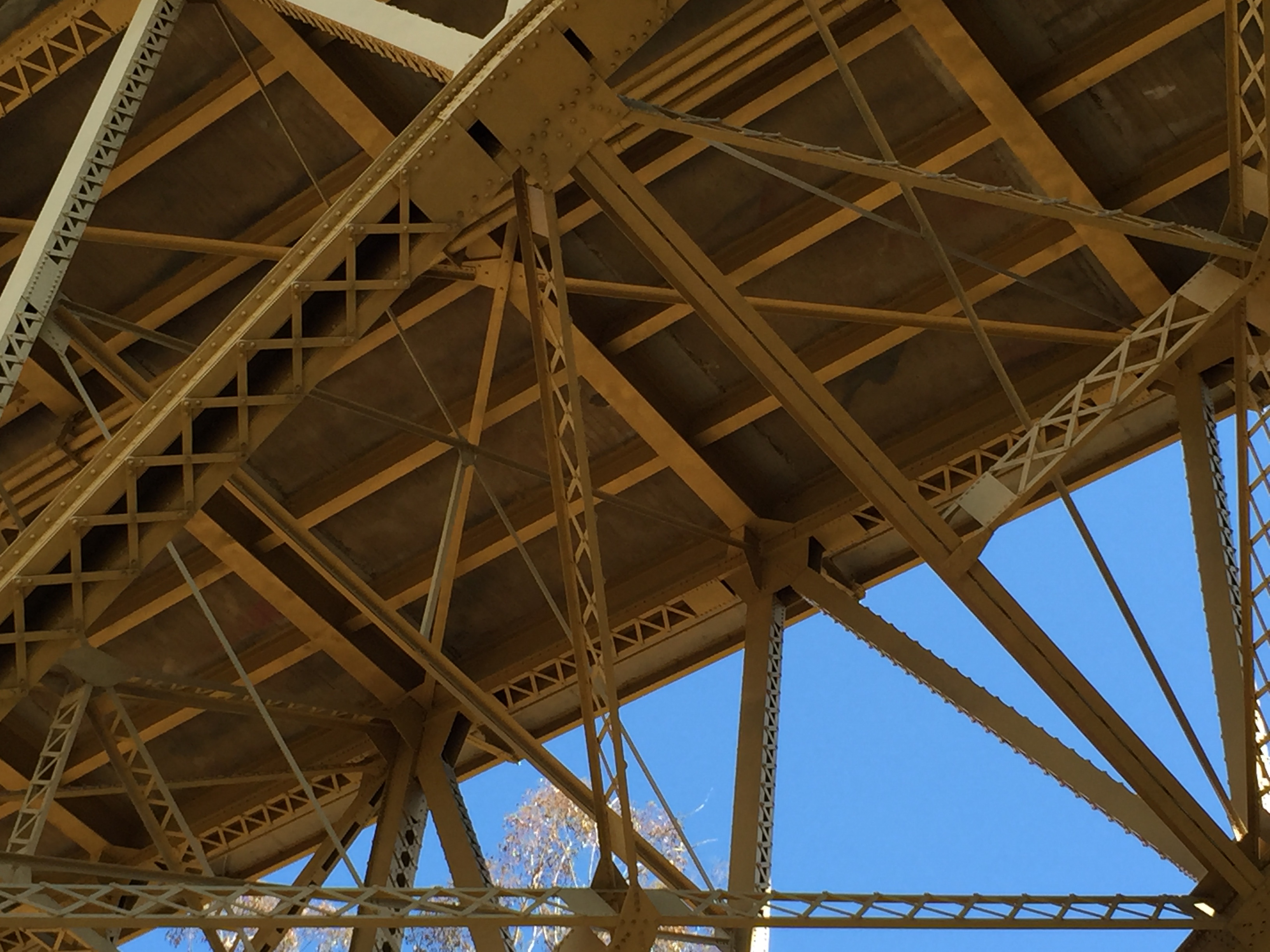
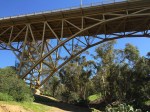
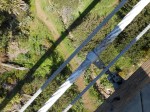
The best place to observe the vehicular/pedestrian First Avenue Bridge is not on top, but rather, from below. Take the canyon trail down to the bottom. Wow! What a gorge! To go from one side of the canyon to the other would be quite a trek. Obviously a bridge was needed to connect the two sides. The canyon was actually disrupting the natural flow of everyday life, separating neighbors from one another. So the locals petitioned the city to construct it in the first place. From below, you can see the result of their request—a beautiful steel lattice structure spanning the gap.
The FIRST, First Avenue Bridge
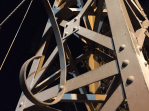
Here, you’re looking at the original “People’s Bridge,” a modest span to meet the need, built in 1911 as a relatively quick and light-weight solution to the problem. It definitely worked for 20 years. Then, it was time to get serious, so the test-bridge was replaced with the permanent version—the one we know today. The crossing was here to stay, and that was a huge victory!
So now, we actually have the new improved version of that 1931 replacement bridge. It has become part of the historic fabric of the city, deserving a $12.7 million make-over. It was completely restored in 2010 to it’s original color and details, looking pretty much like it did when first completed some 90 years ago.
American Sampler
This restored edition of the bridge is truly a piece of Americana. It’s a great example of a steel arch bridge from the early 1900s—the only one in San Diego, and one of only a few left in California. Structurally, it includes about every trick in the book—a real “sampler” of 20th century steel construction. All of the pieces were made and then completely assembled on the floor of a midwestern fabrication plant, then dismantled for shipment to San Diego where it was reconstructed as it is today. The bridge is 463 feet long, 104 feet high and carries nearly 10,000 vehicles daily, linking both sides of the canyon—an essential connector!
Thanks to the many efforts of the local people, the First Avenue Bridge has become not only a time-saver, but also a money-maker and will hopefully remain an important San Diego landmark for many years to come. Power to the People!
Quince Street Trestle Bridge
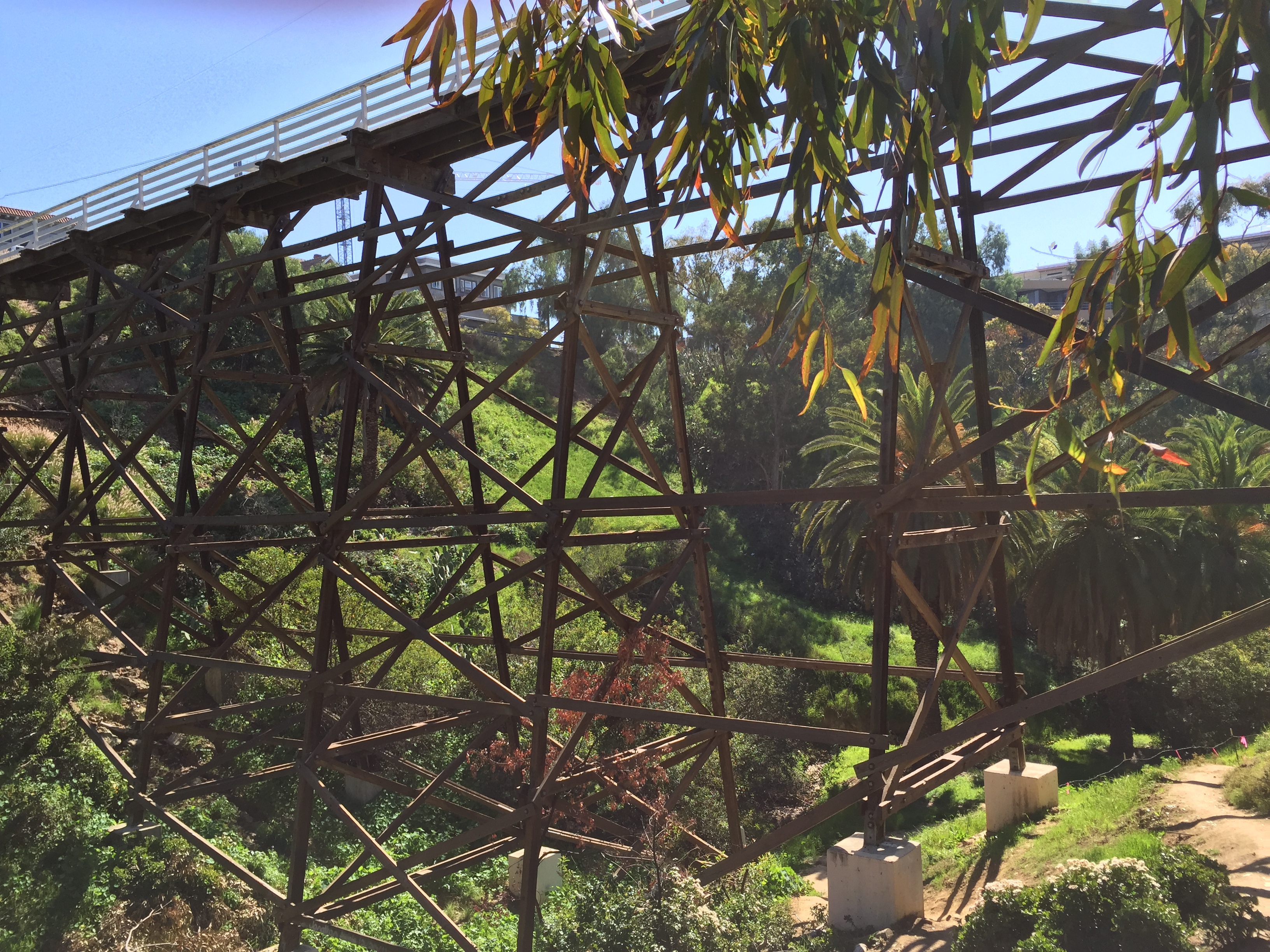
Quince Street Trestle
How pedestrian!
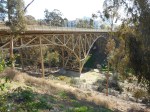
The Quince Street footbridge crossing is one of the few wooden trestle bridges left in San Diego, and it’s a beauty! Originally constructed in 1905 and designed by a city engineer and local resident, George d’Hemecourt, this bridge allowed residents long-awaited access to the Fourth Avenue trolly line—spanning 236 feet at 60 feet above the canyon floor.
This bridge is also testimony to the power of the local people. After suffering years of damage to the wood structure and eventual collapse at one end, it was permanently closed and slated for demolition. That’s when resident Elinor Meadows led the way to have the structure designated a city landmark due to its unique construction. She persevered to victory in 1987 as the city finally agreed that it was an important part of the fabric and history of the city. After more than two years and $250,000, it reopened in August of 1990—revived, rehabilitated and ready to serve a new era of San Diegans.
Spruce Street Suspension Bridge
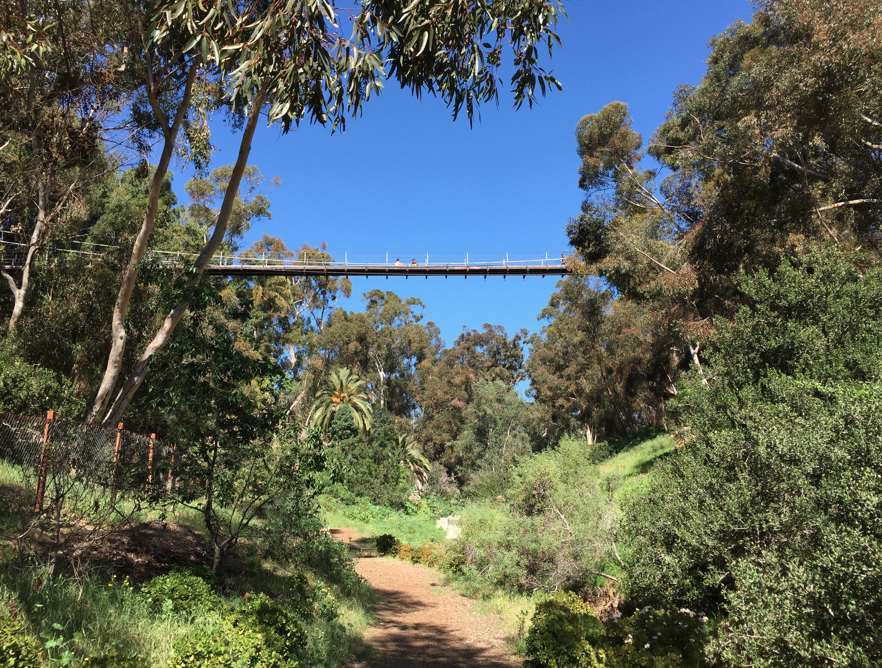
Suspended in time
A bridge so special, it has at least three names.
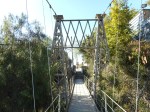
This pedestrian bridge is so magical that it’s location defies naming. Some say it spans “Kate Sessions Canyon,” named after the revered San Diego horticulturalist. However, you can also find the trail under the bridge described as “Spruce Canyon Trail.” Or, you can find a sign declaring it to be “Arroyo Canyon.” For our purposes, we’ll just call it the “Suspension Bridge Canyon.” We will leave the definitive naming of its exact location “suspended” in time, just like the beautiful bridge.
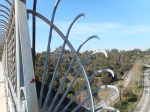
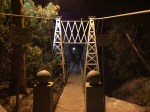
Lay down on the canyon floor and observe the gentle motion of the bridge as it sways back and forth with a slow cool breeze. People find dangling their legs over the sides irresistible, letting themselves be lulled into a sort of twilight sleep by its gentle rocking. Ponder the simplicity of its design as it unobtrusively stretches across the canyon. Next, go up on top—it’s your turn!
Climb aboard
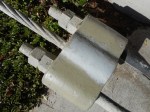
The entrances are especially nice with the mature landscaping closing in around the steel cables. It makes it even more inviting and further accentuates the “secret” feeling you get when walking up to it—compelling. Pause for a minute before stepping out onto the wiggling walkway to notice the structure: the size of the cables, the towers and the connectors anchoring into the concrete—substantial and unique, surely one of the first “moving walkways” in the US?
So there you have it—three very different bridges that all do their jobs exceptionally well: all are functional, unique and grew from the needs of real people with local lives to live. Each one connects point A to point B, yet, creatively solving the problem in a very specific way. They bear the names of real people associated with them, those who cared enough to take action. Because of these bridges, we’re all a little bit closer to each other; more connected in unseen ways; a little bit better than we surely would be without them—bridging the gaps of our lives—bringing us together!
For a pedestrian experience of a different kind, you might enjoy a related post about an incredible hike that meanders around the city of Florence Italy—fantastic views from the surrounding mountains and valleys. The story is called “Renaissance Ring.”
Niki de Saint Phalle was a French-American artist/sculptor, born near Paris in 1930, and died in San Diego, California in 2002. She was a pioneer and celebrated the world over in feminist and monumental art. During the later years of her life she lived in San Diego, where there are many sculptural masterpieces that can be found throughout the area. If you aren’t already familiar with her work, please allow us to introduce you to Niki by way of this digital “tour” of her incredible legacy—culminating in her magical “Tarot Garden” in Tuscany, Italy. Shall we begin? Please follow us!
Mingei International Museum—San Diego
Huge glass marbles
Balboa Park is legendary in San Diego.
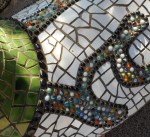
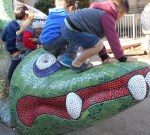
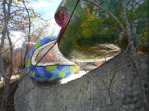
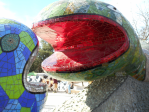
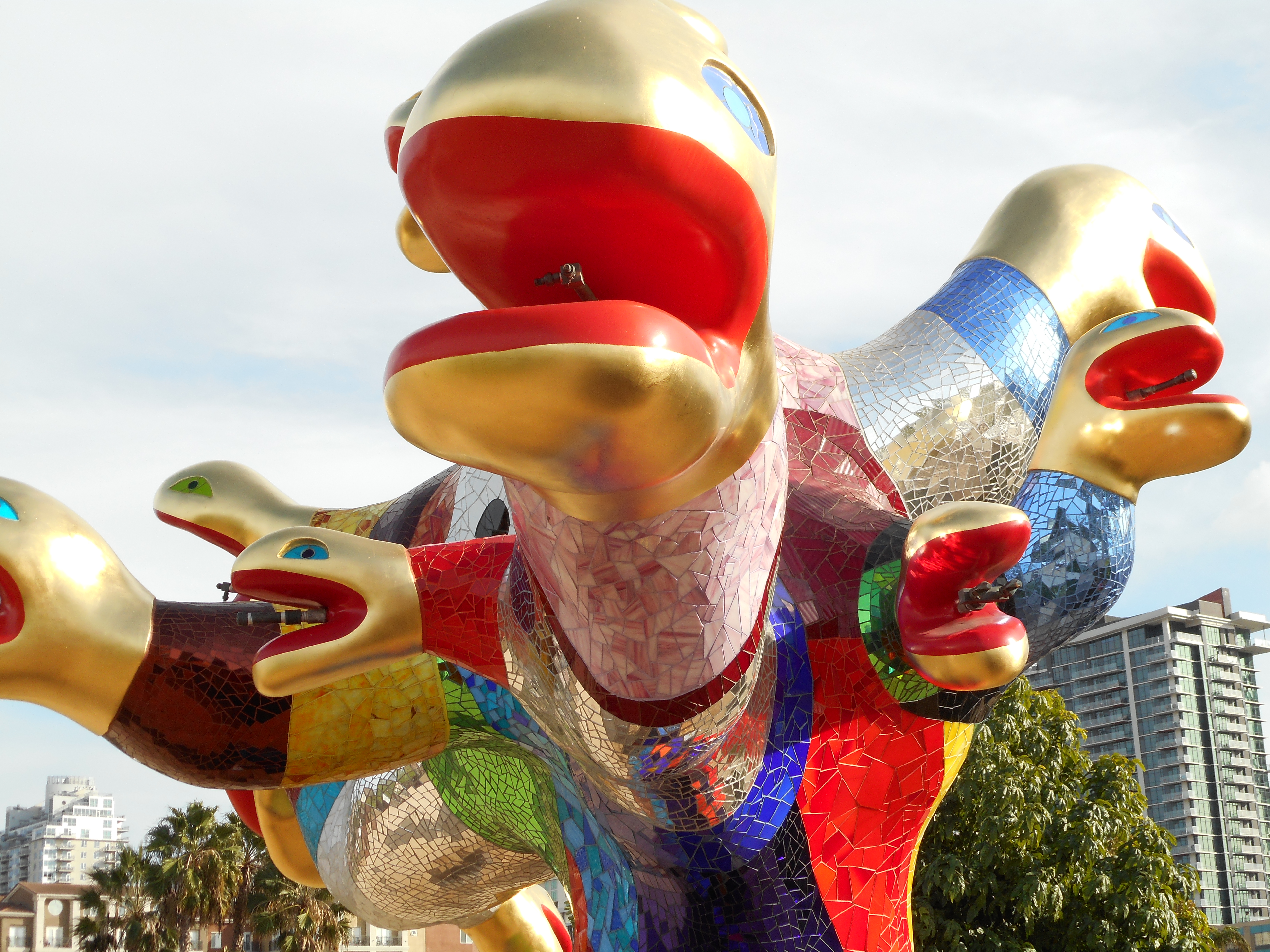
It’s composed of 1200 beautiful rolling acres of urban green space. Several museums, gardens, theaters, and an outdoor amphitheater. Located on El Prado, in the heart of the park is the Mingei International Museum. Outside the entrance is Niki’s “Nikigator—a large lizard-like form made of colorful mosaics and mirrored pieces, inviting children to climb and explore the art from every possible angle. The materials, style and spirit of the sculpture is classic Niki, as we will see throughout this tour. Sit back, spark your imagination and enjoy!
Poet and Muse—San Diego
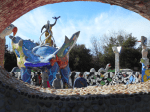
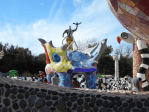
The second sculpture just outside the Mingei museum is called “Poet and Muse,” completed in 1998. This is a two figure piece, featuring a female angel or muse perched atop a male figure. The angel is a favorite motif that Niki uses again and again in her works to represent “feminine energy,” or unbounded creativity. The male form is a bit more buttoned-up in a suit, orange shirt and finished with a red tie.
We wonder if Niki was inspired by Rodin‘s Poet and Muse sculpture by the same name. Perhaps. Rodin also used the female figure as a muse, hovering over a male poet. But, Rodin‘s sculpture created around 1900 is a monochromatic, realisitic, serious carved marble statue, while Niki’s is bright, whimsical, and colorful, with shimmering mosaics. She always enjoyed making her art controversial and certainly used techniques that were unique to her, that others seemingly dared not do. Perhaps Niki was a bit of an idealistic artist contrarian.
Rodin’s “Poet and Muse”
Museum of Contemporary Art—La Jolla
Thirteen miles up the coast is La Jolla Village, where more Niki sculpture lives. Although it’s technically located “in the museum,” it’s actually in the garden area behind the museum which makes it easily accessible, as well as free! The first thing you’ll notice about this piece is that there are no mosaics. Big Ganesh is smooth and painted to be compatible with the previous Niki style, but is made of fiberglass instead—a technique that Niki used for many of her later works.
Ganesh(a) is one of the best known gods in Hinduism and is the remover of obstacles. Ganesh is depicted as having a human form, but with the trunk of an elephant, Traditionally, riding on a lowly mouse. Here, the mouse has gained independence and is actually standing alongside Ganesh—a companion in equal standing—the much preferred Niki interpretation
Sun God—University of California San Diego
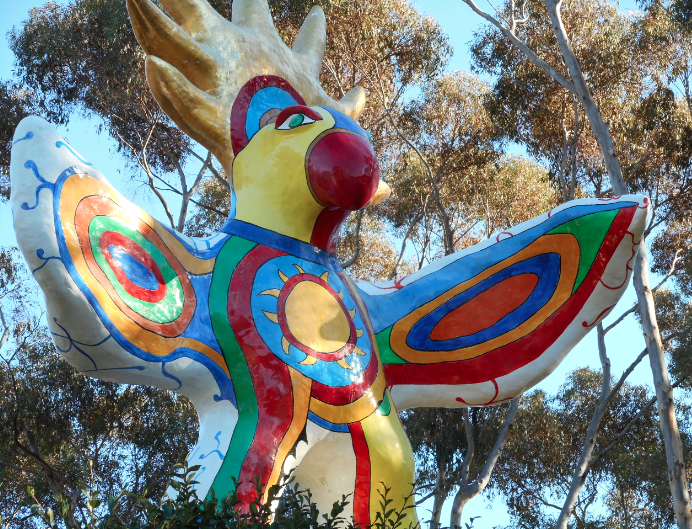
Perched atop a topiary hedge, Sun God watches over a peaceful grassy area on the UCSD campus. Installed in 1983, it was Niki’s first outdoor commission in the US. The fourteen-foot bird is made of painted fiberglass and is carefully hidden from view within the greenery.
The Sun God is a deity celebrated in many myths and religions. In Hindu, it’s a Bird God, while Helios (Sun God) was the Greek version. Perhaps Niki’s Sun God blends these two entities into one magnificent creature.
In July, 2016, Sun God received a “make-over.” Restorers removed the original paint down to its base layer. The paint had suffered cracking due to its proximity to the ocean. After removing the surface damage and sanding the base coat, the sculpture received fresh acrylic paint. Finally, clear coats were added to seal out the harsh elements. The next restoration will most likely not be needed for another 20 years. We hope!
Kit Carson Park—Escondido
About 17 miles northeast of Sun God, is the town of Escondido. The park there is a delightful place for a picnic or family outing. But, in addition to being a destination, the park has the distinction of being the site of Niki‘s amazing sculpture garden—Queen Califia’s Magical Circle. It’s the last major international project that Niki created, which was completed in 2003. Nine sculptures are encircled within a serpentine wall. All of the pieces are mosaic with ceramic and mirrored tiles.
Queen Califia on Eagle
Queen Califia stands on the back of a five-legged eagle in the center of the garden. The surrounding totems include representations and symbols from many cultures, including Native American, Mexican and Pre-Colombian. As is typical of her style, Niki embraced and interpreted these cultures through her vivid imagination. The result is both fantastical and whimsical, yet always highly provocative. The playfulness of her work can sometimes hide the seriousness of her underlying messages.
Queen Califia was a warrior-queen who ruled the mythical island of California. The fictional character was invented by Spanish writer Garci Rodrigues de Montalvo around 1500. Califia’s story is the reconciliation between Islam and Christianity, probably representing the struggles between the two religions which had collided in Spain. Califia is also thought to be the preferred depiction of California, symbolizing bounty and beauty with an untamed nature.
Coming together—back in downtown San Diego
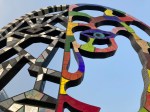
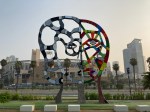
This is one of our favorite pieces. It stands majestically in a small garden, adjacent to the Convention Center on beautiful Harbor Drive. Niki’s design depicts the human challenge of integrating the opposing forces within all of us—the wholeness that comes from acknowledging the yin and yang of our existence.
The sculpture speaks to our ephemeral and delicate nature with the lacy design—almost invisible and translucent at times. The striking task she highlights is to bring the two halves of our existence together, integrating the shadow, depicted in the black and white portion of the sculpture, with the incredible bright colors reflecting the light of our limitless possibilities. The colors and contrasts on a sunny California day are awesome, much like the beauty of human form.
You may want to visit our “Behind the Scenes” story about Niki and her “Coming Together” sculpture—We call our story “Neither Black Nor White. Just click on the title.
Waterfront Park—San Diego
Serpent Tree
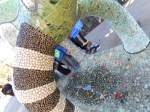
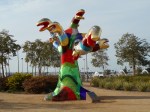
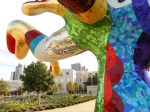
Three whimsical Niki sculptures grace Waterfront Park: Serpent Tree, Cat and Baseball Player, forming a trio of playful pieces that are irresistible to children and adults alike. The sculptures are on loan from Niki’s charitable foundation, but hopefully will be able to stay long term, making Waterfront Park the perfect location as their permanent home. Swing by and take a look, and maybe even play for a while!
The Tarot Garden—Tuscany, Italy
Niki discovered the incredible work of architect Antoní Gaudí in Barcelona Spain and was inspired to create her own magical park in Italy. She found a large wooded property to develop in southern Tuscany where she would design and build her fantastic creations—each year a new sculptural form emerged, peeking out above the tree-tops. This ongoing project was truly the culmination of her life’s work as an artist/sculptor.
Allow us to take you there by way of the following short video. The house you will see that’s literally built inside an enormous woman—Black Nana, as she called her, was Niki’s home where she would live while working every summer on her forever growing garden paradise. The Nana series was a favorite that Niki sculpted again and again, representing feminine energy. She created black versions, as well as white.
Notes/Credits
The mechanical sculptures shown in the Taro Garden video were done by Niki’s husband Jean Tinguely, a famous Swiss sculptor. They completed many projects together over their lifetimes.
Niki and Jean
The beautiful opening photo of Niki with a stylized snake painted on her face was first seen in the French Quarter magazine in an article called “Niki de Saint Phalle, French-American Heroine.”
Niki’s work can also be found around the world in Paris, France; Nice, France; Kiryat Hayovel Jerusalem, Israel; Stockholm, Sweden and Zurich, Switzerland. You will also find a number of artists with similar works that were influenced by her style.
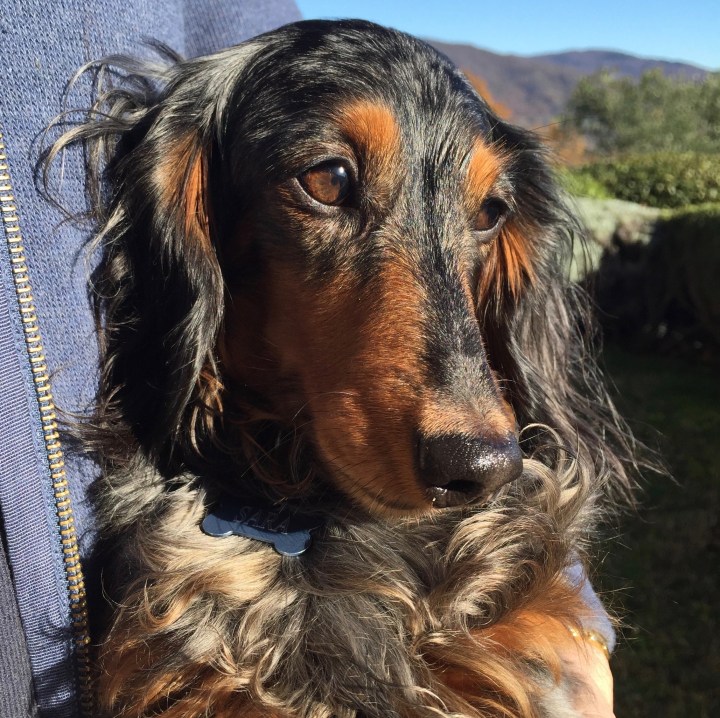
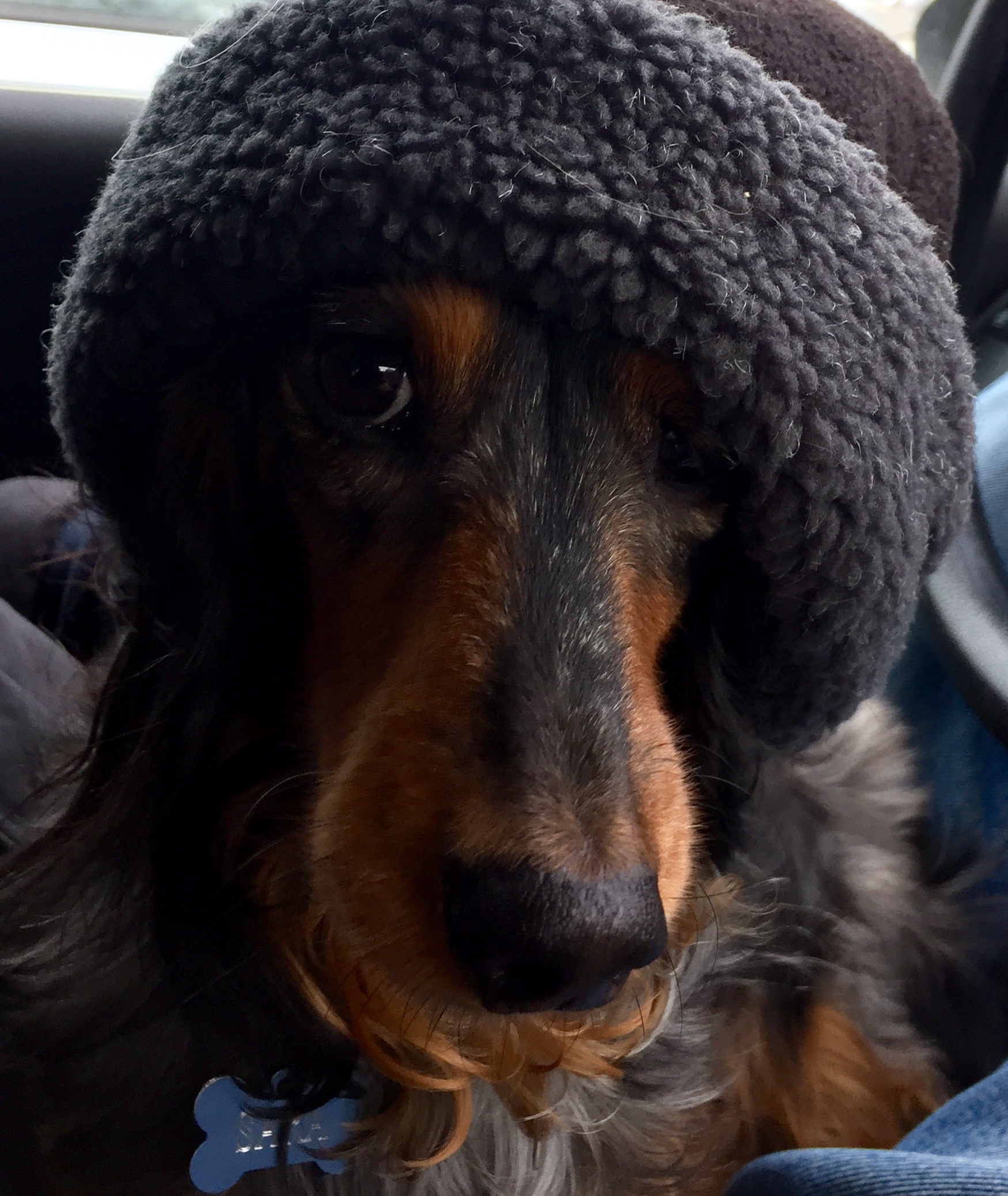
Welcome to an amazing episode in the continuing story of Sara, the Wonder Dachshund. Cheryl: I will tell this story as best I can from the details Em recounted as he lay on the sofa recovering from his “urgent adventure” with Sara.
Secret weapons – nose and empathetic eyes
Dogs are incredible creatures. Did you know they have about 300 million smell sensors in their noses—about 50 times more than we do, mere humans? On top of that, their brains are 40 times more capable of analyzing those smells than the big person next to them. As if that isn’t enough proof, they can also sense pain/distress and will come to your rescue, trying all their wiggly, licky tricks to comfort and console, or even just lay on you. Anything to heal and make things better. We call it fur-therapy. Now, that’s a “best friend!”
Shivering Sara
The other day, Em was experiencing his share of stress around long-overdue feedback on things like relationships, communication, negative behavior, leadership style etc.—you know, ordinary things like that. He was working at the computer when our little longhaired dachshund Sara came to his side and wanted something. He picked her up to find she was shaking uncontrollably, which was really unusual. Thinking she might desperately need to go out, he leashed her up and hurried out into the grass. She did a token tinkle, but immediately started heading east across the lawn, pulling hard like there was something urgent that needed her attention (also not like her).
Trolly and train crossing
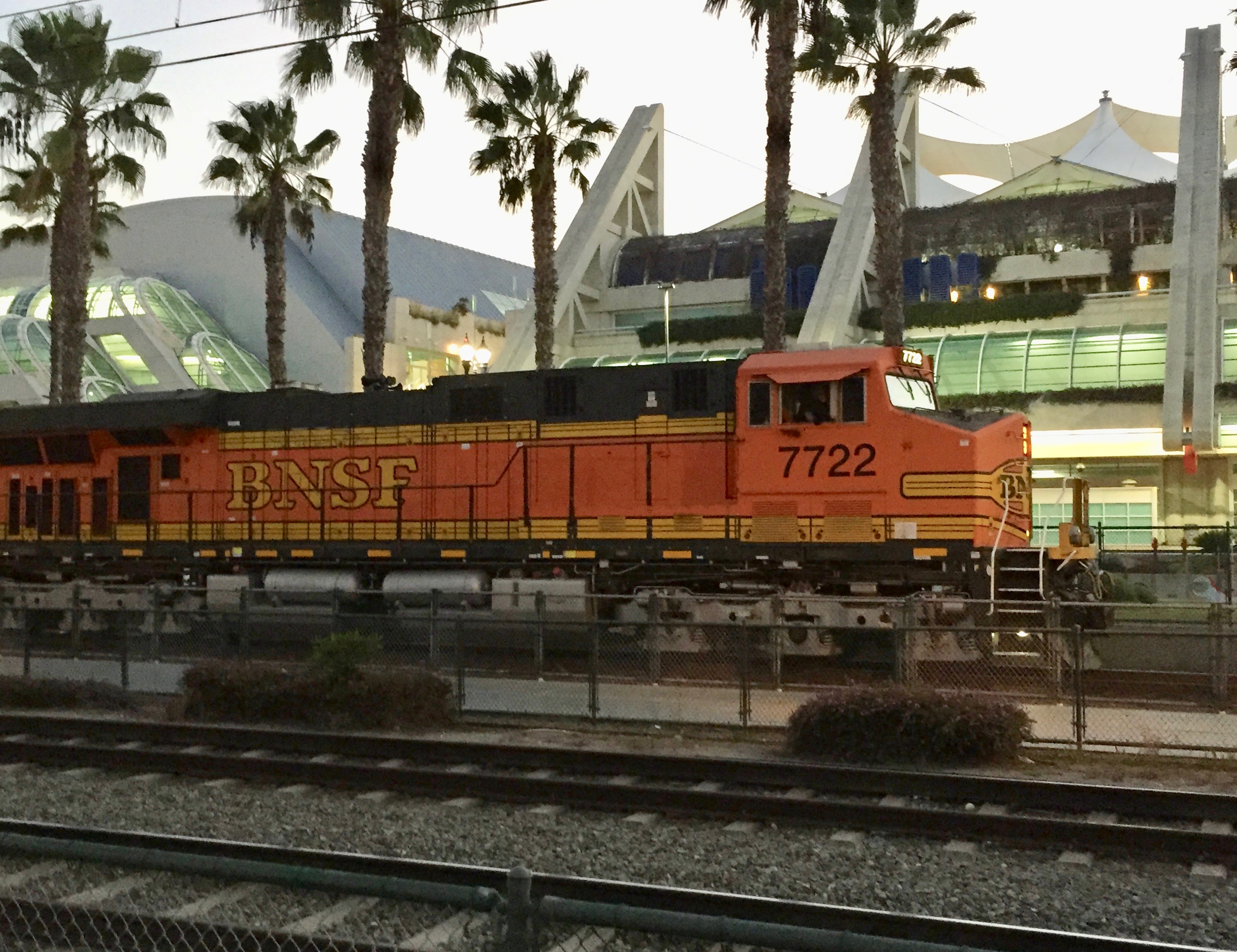
The leash was taut with Em in tow. Laser-focused, she jumped the curb and jaywalked them across Union Street. She stopped, momentarily sniffing and inquisitively looking up at a man on a platform 15 feet away—but no, he was not involved in this chase. Lurching left, she ran through a parking lot where she had never been before. Leaving the lot, she sniffed out a signal and immediately took a right turn, south down the sidewalk toward the trolley tracks. Then they bolted across the tracks where Em had to literally hold her at bay while traffic cleared on Harbor Drive. When the light changed, they were off again on a tear across six traffic lanes and a median of palm trees.
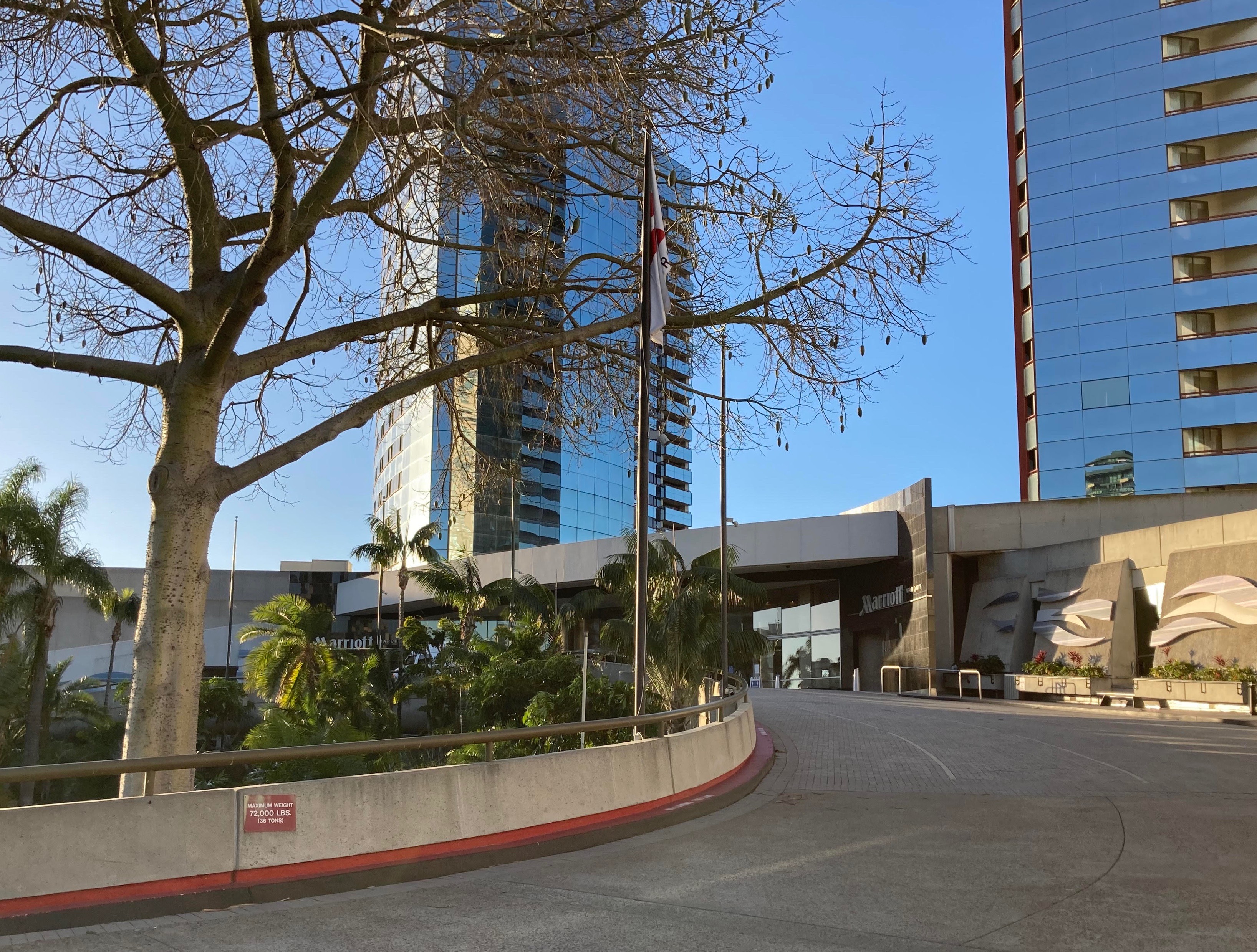
Marriott entrance
Without hesitation, she jumped the curb on the other side and launched up the ramped-drive toward the Marriott entrance. Sniffing as she ran, they circled around past the entrance (thankfully they didn’t need to go inside), taking a hard right toward the loading dock. Holy Moly! Em yelled to the guard as they darted by, asking if it was okay if they passed through to the other side. He said “the guard at the end will definitely open the gate since he’s afraid of dogs,” as he laughed out loud. Em shouted-out a quick “thanks” as his hair wafted in the breeze of the loading dock wind-tunnel.
The wind tunnel
Like clockwork, the guard opened the gate as they fast approached—a perfectly orchestrated team event and they were off and running toward the promenade along the marina. Those little dachshund legs were a blur as Sara scurried and sniffed her way to some unknown destination. Em mused that this time, the leash was pulled tight enough to pluck a low Bb, like on a stand-up bass.
They then crossed the promenade where she did the most remarkable thing: she literally jumped up on the bayside retaining wall (never before had she done such an exuberant thing in her entire life), and stood there like a statue looking out over the water. Evidently, the mysterious fugitive had made a cool get-away—apparently confounding his scent amid the boats gently rocking in the bay. After a moment of determined gazing, she jumped back down onto the promenade and then retraced their exact route back home—still sniffing and pulling Em along behind her like a man obediently following his fearless leader.
Ready to sleep
Arriving at home, they went inside as if nothing unusual had just happened. Sara immediately fell asleep. Em and I puzzled over her urgent adventure, wondering what in the world it was all about. Since she can’t talk and has no opposable thumbs to write her story, it remains a mystery. Then, a possible explanation dawned on us: What if she had sensed Em’s stress about insensitivity and over-assertiveness—his “leadership crisis”? She knew he needed help. We imagined her concocting a little adventure, combining her expert sense of smell with her innate human sensitivity to teach that “old dog” a new trick?
She decided to give him a first-hand experience that he would hopefully NEVER forget: the importance of learning how to FOLLOW.
It seemed a simple question to pose to two Italian realtors. Without hesitation, we soon had our answer. Almost immediately, the more practical of the pair, feisty Inga, was at the wheel, maneuvering the old Jeep up the steep terrain. Her associate, Patrizia, stunning in her white knit pants, fitted shirt and lavender scarf tied stylishly around her neck, occupied the passenger seat. As Inga revved the engine, Patrizia turned and smiled to reassure us that everything was okay. Just after we turned off of the main road, Inga immediately threw her weight into the steering wheel for a hard left and we continued a steep climb. At one point, all we could see from the back seat was the dashboard because the road was completely obscured from view, due to the car’s jolting angle. Surely, this must be the top, we thought, as the grade leveled out a bit and we found ourselves passing between enormous old vacant barns and rusted grain silos. Inga paused only momentarily, grimacing as she engaged a stubborn gear, and then yanked the steering wheel hard to the right and away we went into the woods.
Arriving at the top of the mountain
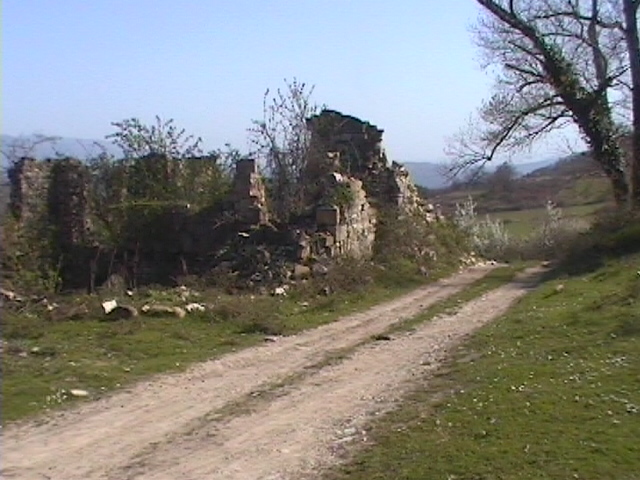
Surprised, we continued to climb up the rugged hillside, while brush and bushes slapped both sides of the Jeep. Rocks rolled down the hill while others crunched beneath the spinning tires as we bounced and jostled our way along. We felt a sudden lurch as Inga course-corrected after unintentionally dropping a tire into a huge pothole. Patrizia turned once again to offer another cautious, silent smile of reassurance. A few hundred feet further, Inga nearly stood on the brake pedal, bringing the Jeep to an abrupt halt. She then shifted into neutral, cut the engine and with a sharp tug, engaged the parking brake. Just for good measure, she kicked a large stone under the back tire. Then, as if nothing unusual had just happened, Patrizia smoothed her hair, adjusted her scarf and said with a gracious smile, “Andiamo, let’s go!” We emerged from the back seat to see—ruins. Not just something in need of minor repairs—serious ruins.
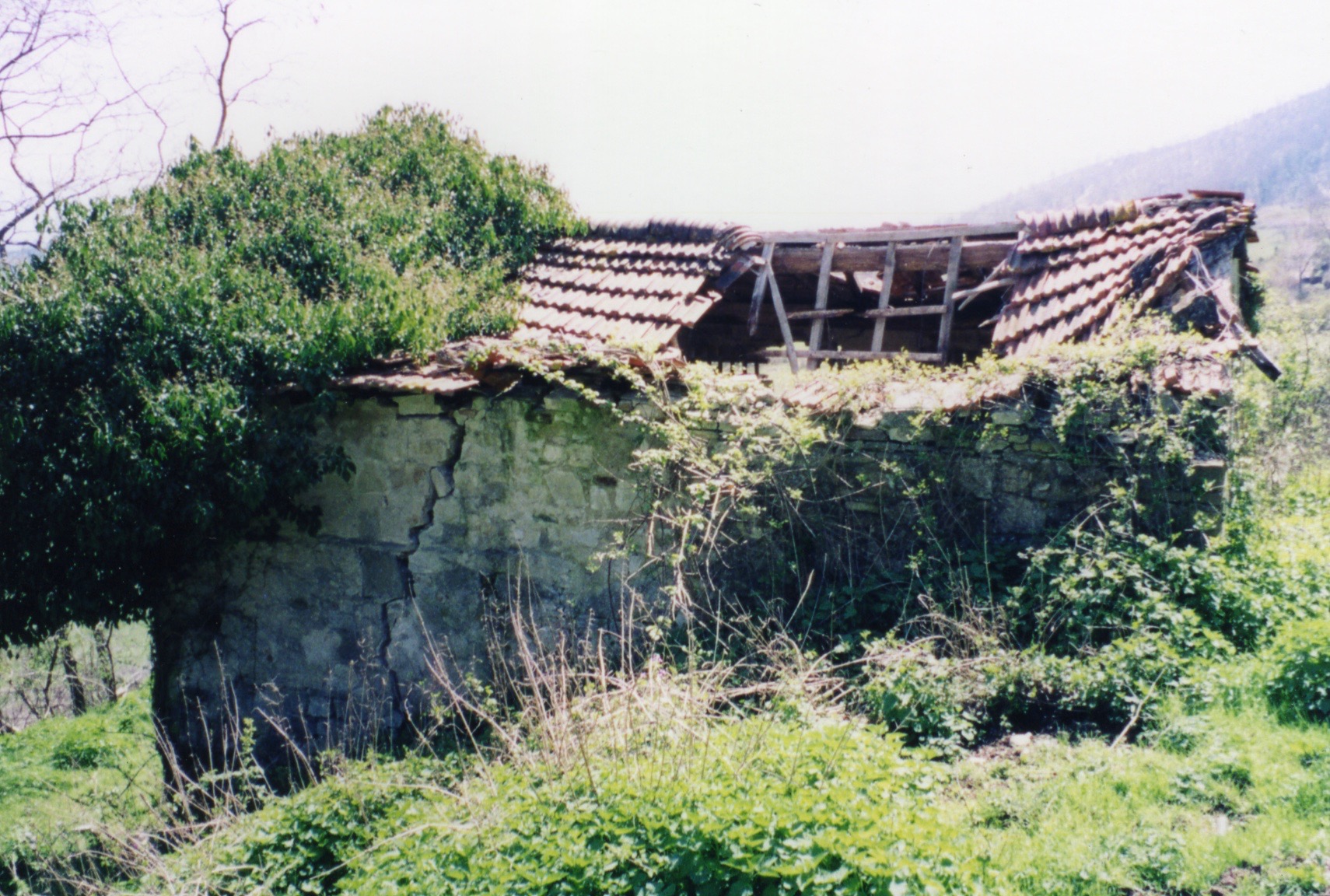
Barn In Ruins
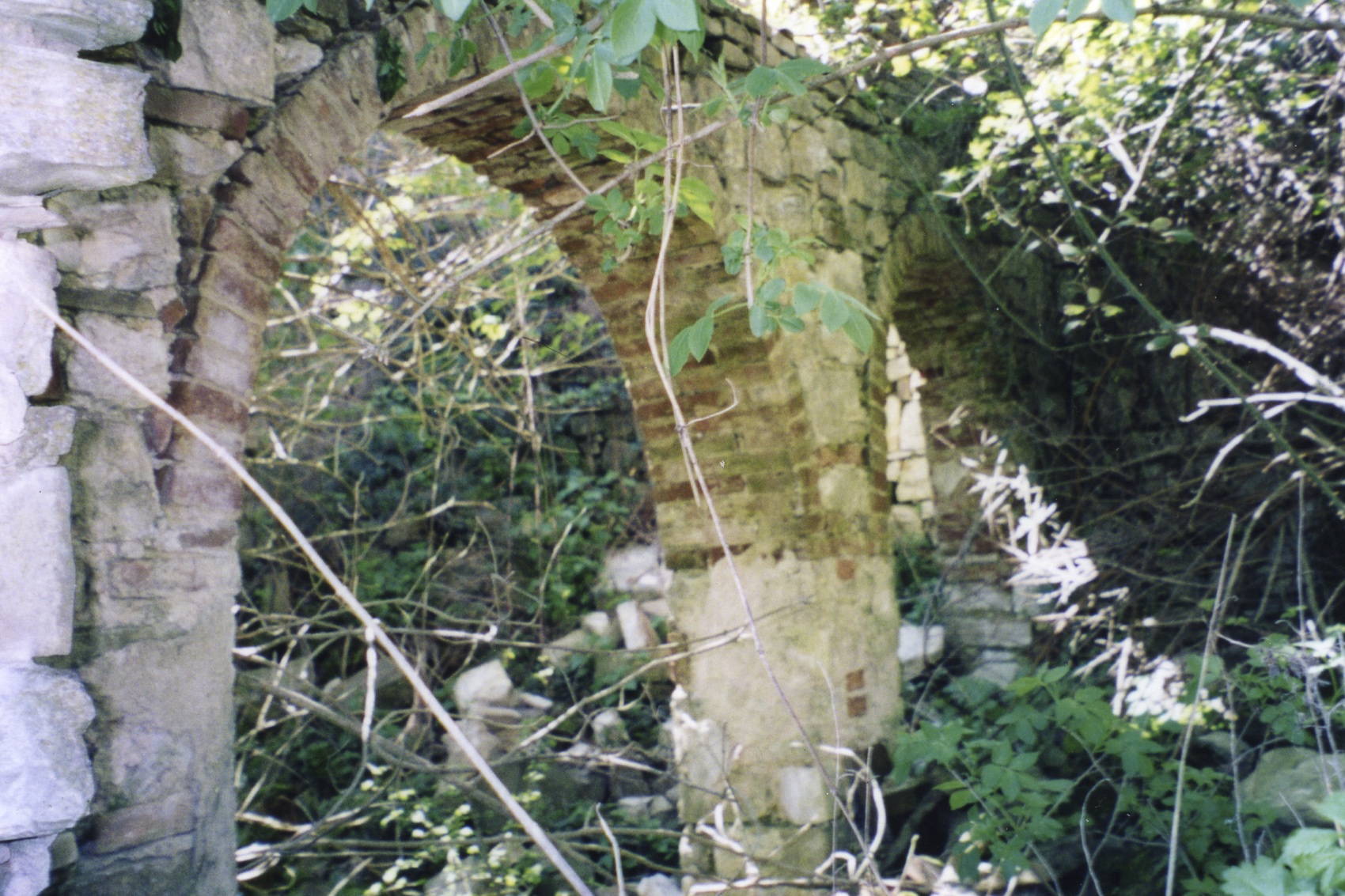
There before us, was a small, dilapidated stucco, terra cotta and stone barn with a 3-inch wide diagonal crack running from its fallen roof all the way down past its dirt floor. Near the barn stood the delicately balanced pile of stones that once was a large house, as evidenced by a remaining 10-foot high stone corner. One wall jutted up far enough to hold the crumbling remnants of an old stone window opening. The adjacent partial wall was completely overgrown with vines that had surely gone unchecked for at least—umm, maybe 100 years?
Overtaken by nature
We couldn’t get too close to either the barn or the house, since brambles and weeds obstructed our way, completely covering the lower levels. We heard wild pheasants warbling in the nearby meadow. With nimble fingers, we lifted thorny branches and edged cautiously closer, remembering that in the undisturbed, abandoned parts of Tuscany there were undoubtedly many resident snakes—vipers among them—watching our every move.
The peaceful valley
We stood, staring from the ruins into the magnificent valley below. From that perch at the top of the hill we saw multiple layers of blue and gray mountains receding into the distance. Directly below us was an intimate valley in various shades of lush green vegetation. The landscape was broken with the occasional yellow stucco farmhouse, a castle tower and a couple of grand old villas. Silvery grey olive groves dotted the hillsides. Vineyards followed the contours, rolling like gentle green waves. On our far left, nestled within a distant pine grove stood a centuries-old monastery, Madonna del Sasso, with its own commanding view of the amazing valley. We were mesmerized, taking it all in, gazing into the distant past, smitten by the current breath-taking view—lovestruck.
Patrizia casually mentioned that Dante Alighieri, had a country home just down the hill in the late 1200s. She went on to say that he even penned his famous Divine Comedy while staying there. We were lost in thought. Then, after several minutes of silence, she said, “Allora, che pensate, so, what do you think?”
Her question snapped us back to reality. With a quick glance and subtle nod to each other, we answered, curiously at the same time, “Perfetto, perfect!” Inga and Patrizia locked eyes and slightly raised their eyebrows. We’re sure we heard one of them utter to the other, “Pazzi Americani, crazy Americans!” Yet, we knew better. These RUINS would be the source of our inspiration. To rebuild the fallen stone walls was the perfect metaphor we needed to begin building our own dreams.
This story is a true “Italian Moment” that took place in the spring of 2000.
What has a specific beginning and end, but no origin?
The labyrinth.
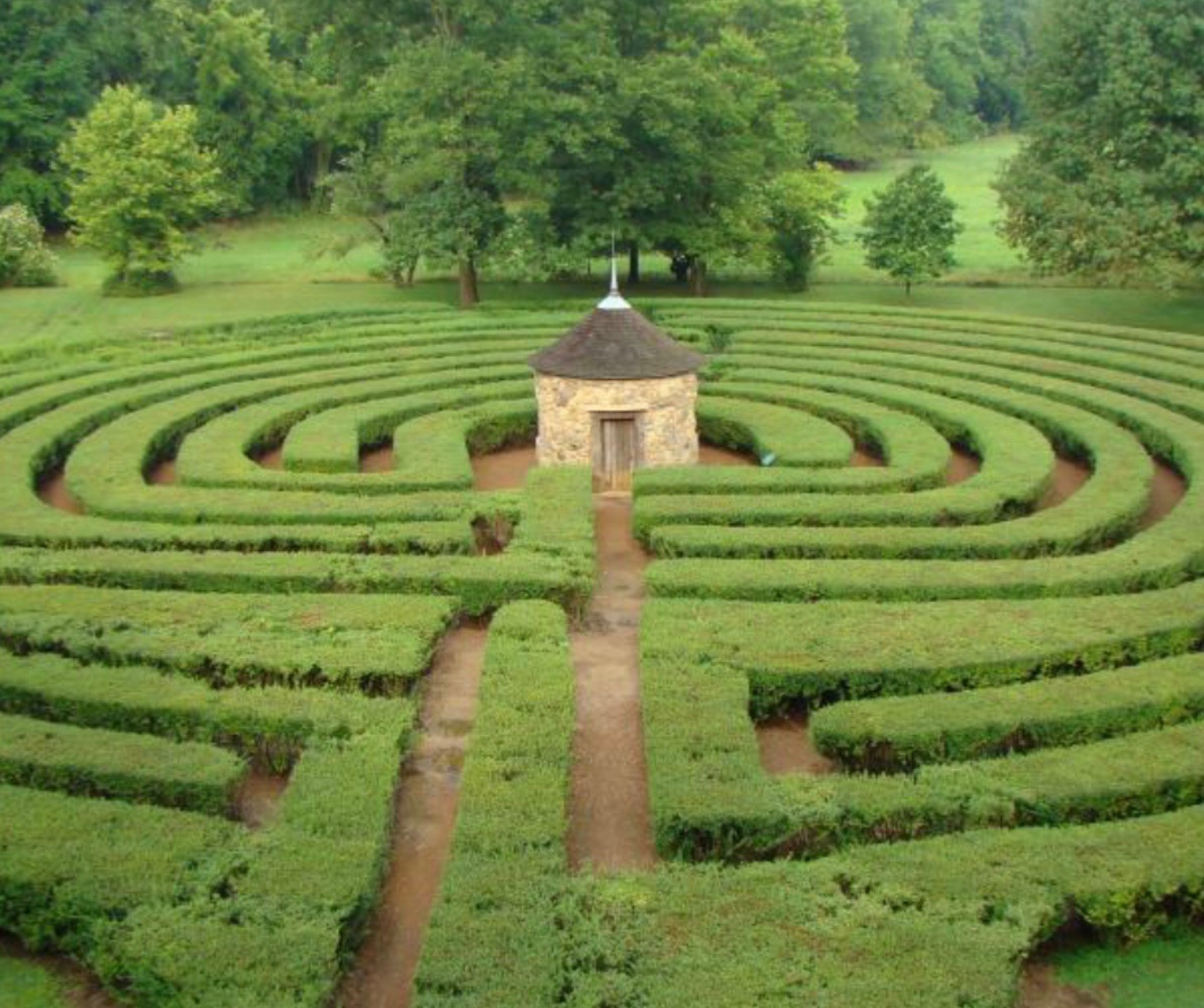
Rappite Labyrinth, New Harmony Indiana
Labyrinths have been discovered throughout the world for at least 4,000 years. But that doesn’t mean we know who invented the first one, or where. Was he/she as old as dirt? Who really knows? However, something timeless and mysterious seems to tie them all together as if by a grand plan, yet no obvious big plan exists. Each labyrinth is more like a symbolic representation of some primordial pattern. And, that idea seems to have been hardwired into every brain in every culture. The labyrinth represents a common shared experience of living, making a journey, meditating on the meaning of life, achieving a goal or simply following your personal path—one step at a time. It is a metaphor for life itself. Even if we don’t know the exact origin of the labyrinth, we can all agree that it’s a powerful idea that remains meaningful and fully embraced to this day.
Kitchen Jar Opener—A Necessity
Nobody thinks much about a labyrinth until you’re presented a mysterious and urgent need for one. They’re like that special jar-opening tool in the kitchen that you need RIGHT NOW! There must be one around here somewhere, but where is it? (freeing the stubborn lid from a jar is reminiscent of a labyrinth’s ability to ease the cross-threaded barriers to living our best life). Well, we found ourselves in need of a labyrinth one day. One of us had a vague recollection of something like that just down the street from our place. You know the feeling? You’ve seen it out of the corner of your eye, but didn’t really pay that much attention. There was something that looked more like a garden sculpture in the center of some hedges. But wait. Upon closer inspection, a bold discovery was revealed—a fantastic contemporary labyrinth “right there in our own backyard.”
“Eureka!” We found it!
Labyrinth Tower—San Diego California
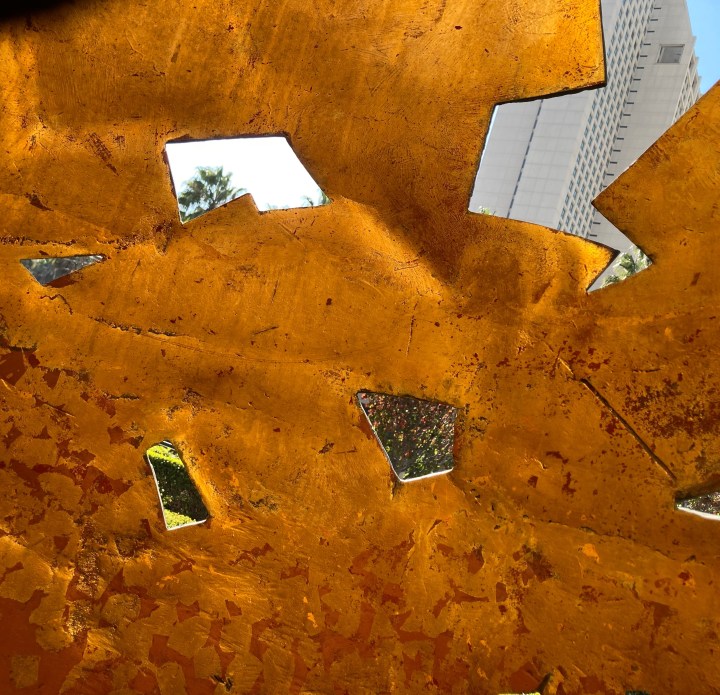
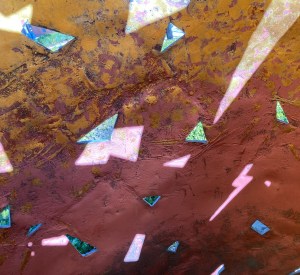
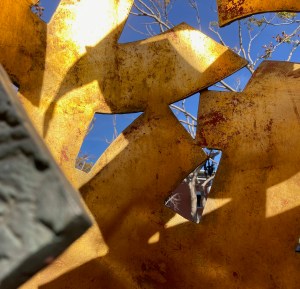
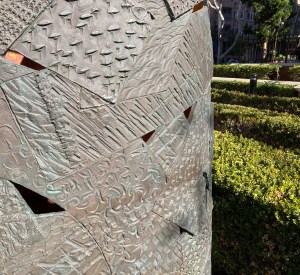
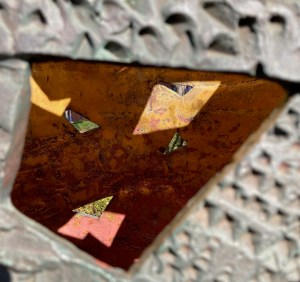
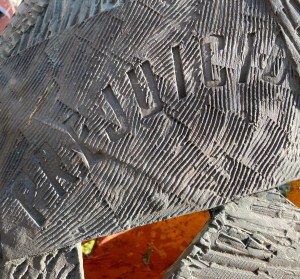
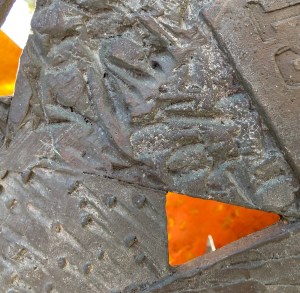
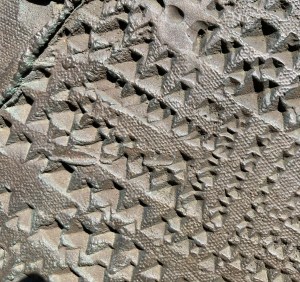
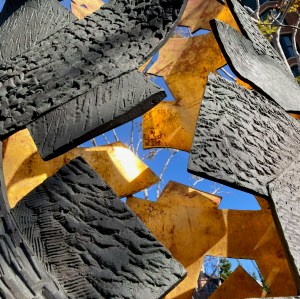
Twenty-five years ago, three artists were commissioned to create a piece of sculpture to commemorate the beginning of the “Martin Luther King Jr. Promenade” in downtown San Diego. Their idea was to create a labyrinth with messages set into concrete bordering a stone path. The series of phrases prompts the meditative walker to consider the ways we can grow by “shedding” that which is limiting and/or no longer useful. When we shed negative attributes, we create space to “don” positive qualities. The short walk culminates at an incredible bronze tower, apparently built from transformed scraps of metal, which may symbolize that “shedding/donning” process—soaring upward into the beautiful blue Southern California sky. The sculpture is impressive yet unfinished—much like our own life’s work. True transformation seems to require examining the negative to glean the positive. Which is the dismantling and which is the building? Hmm. Perhaps they’re one and the same.
In either case, there’s definitely important solitary work to be done . . . one step at a time!
Labyrinth Messages
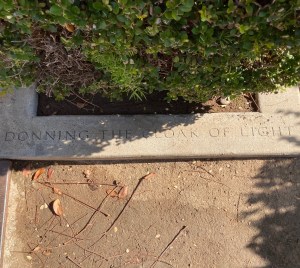
Stepping into the labyrinth, there’s a concrete border on each side of the gravel path. Alternating from one side to the other as you walk are messages engraved in the borders—with “shedding” on one side and “Donning” on the other, as follows:
Shedding the cloak of Oppression”—”Donning the cloak of Reconciliation” Shedding the cloak of Fear—Donning the cloak of Trust Shedding the cloak of Prejudice—Donning the cloak of Respect Shedding the cloak of Malice—Donning the cloak of Compassion Shedding the cloak of Bitterness—Donning the cloak of Forgiveness Shedding the cloak of Despair—Donning the cloak of Hope Shedding the cloak of Weariness—Donning the cloak of Courage Shedding the cloak of Ignorance—Donning the cloak of Wisdom Shedding the cloak of Darkness—Donning the cloak of Light
Gallery
Cheryl & Emerson
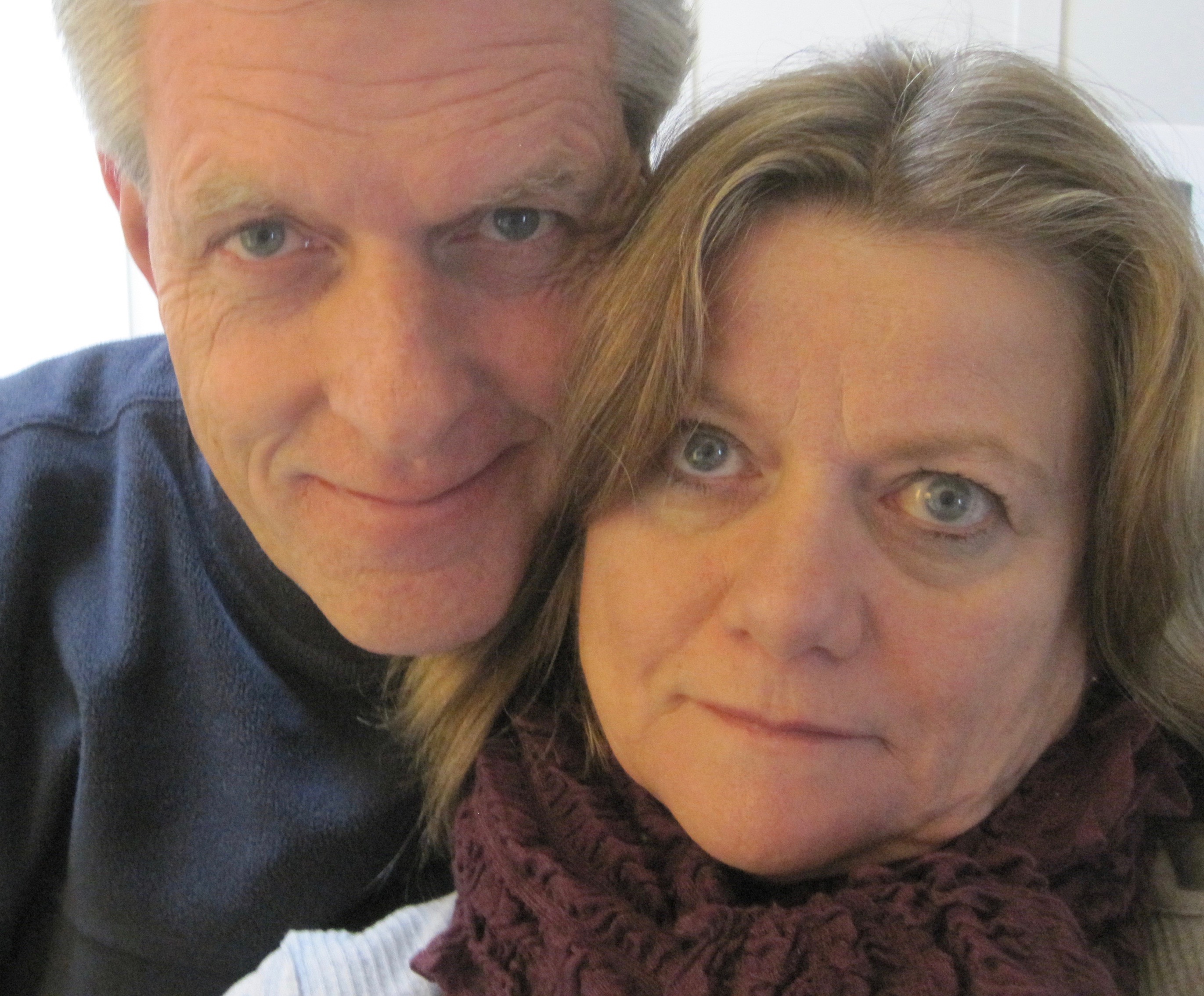
Quality time is undeniably great for relationships. We've discovered that quantity of time can provide that quality. Perhaps it takes Time to Partner.

























































































 Quality time is undeniably great for relationships. We've discovered that quantity of time can provide that quality. Perhaps it takes Time to Partner.
 Uncommon promise